


- This event has passed.
The Night Sky at Stonington Lighthouse Museum
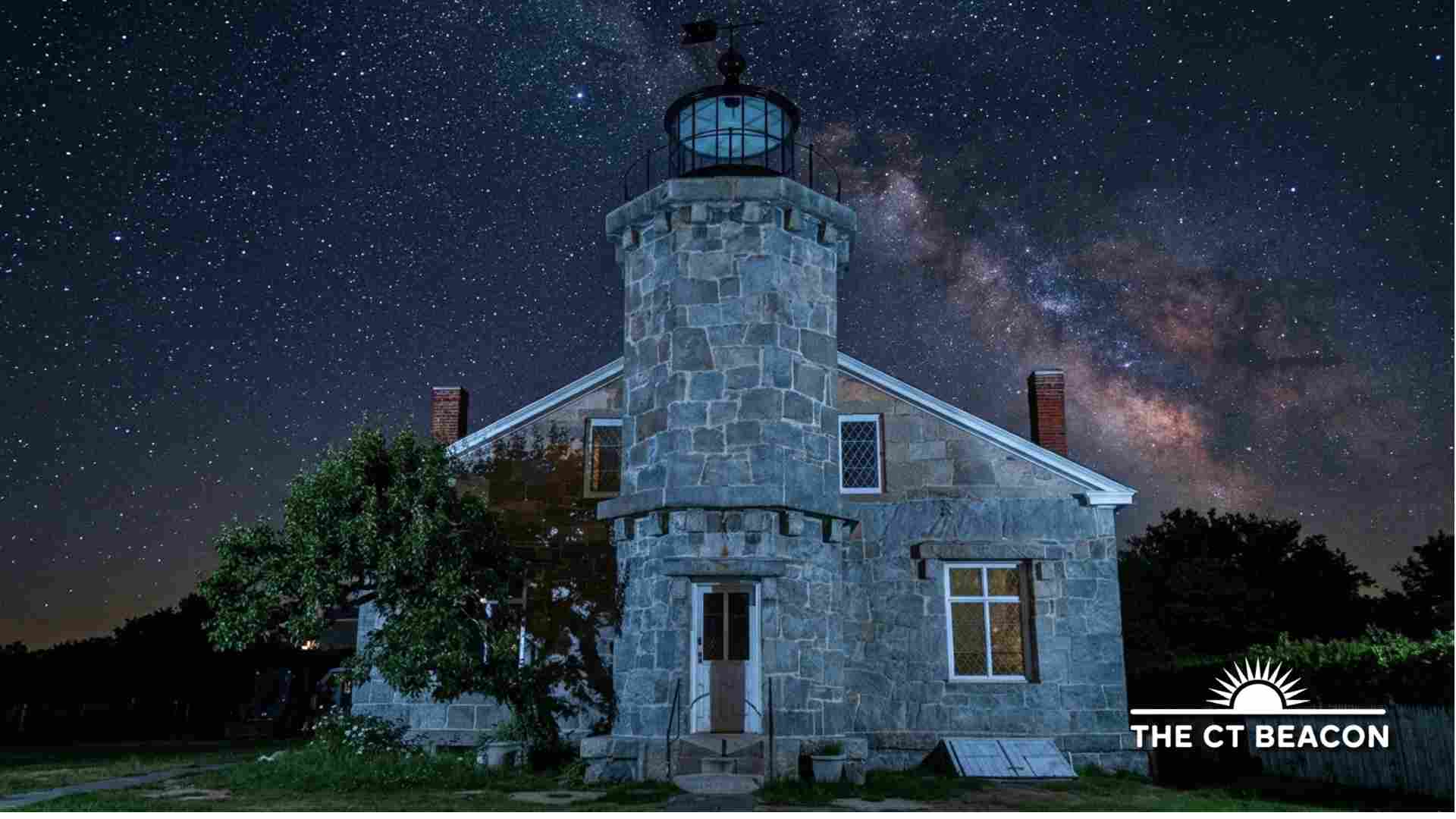
The Night Sky at Stonington Lighthouse Museum begins a new evening series on Thursday, September 10, with celestial navigation, maritime history and stargazing on the waterfront grounds of Stonington’s historic 1840 lighthouse.
Brian Koehler, Associate Director of the Treworgy Planetarium at Mystic Seaport Museum, leads the first program, exploring how mariners once used sky observations to determine their position at sea and how those techniques relate to sailors from Stonington’s maritime past.
The evening runs from 8 to 10 p.m., with Koehler’s presentation beginning at 8:30 p.m. Guests are encouraged to bring a blanket, pack snacks, and settle onto the lighthouse grounds for an evening under the stars.
Finding Your Way Before GPS
For centuries, going to sea meant learning to read the sky.
Celestial navigation uses observations of the sun, moon, planets and stars to determine a vessel’s position. With instruments such as a sextant, navigators could measure the angle between a celestial object and the horizon. Those observations, combined with accurate time and navigational calculations, could tell sailors where they were even when there was no land in sight.
It was practical knowledge, not simply astronomy.
That connection between the sky and the sea is at the heart of the Treworgy Planetarium, where Koehler works today.
The planetarium at Mystic Seaport Museum was established in 1960 specifically to teach celestial navigation. Its role has expanded considerably since then, but maritime navigation remains central to its identity.
In recent years, the planetarium has even redesigned its exhibits to tell a broader story of how people around the world have used the sky for navigation and wayfinding.
Brian Koehler Brings the Planetarium to Stonington
Koehler has led the Treworgy Planetarium since 2013 and now serves as its Associate Director.
His work has emphasized the practical side of astronomy, particularly the relationship between astronomical observations, seafaring and navigation.
Koehler has taught celestial navigation in settings ranging from planetarium programs to hands-on maritime experiences. In October, he’ll take that instruction onto the water aboard Mystic Seaport Museum’s schooner Brilliant for an overnight program in which participants learn navigation techniques ashore before putting them into practice at sea.
He has also presented programs explaining historic navigational instruments and how mariners could chart a course using the sky.
For The Night Sky, that knowledge moves about five miles east from Mystic to a place where celestial navigation has deep local relevance.
How Nathaniel Palmer Found His Way Across the World
Historic Stonington is using one of the Borough’s most famous mariners to connect the science with local history: Captain Nathaniel Brown Palmer.
Born in Stonington in 1799, Palmer went to sea as a young man during an era when Stonington was deeply connected to sealing, whaling and international maritime trade.
In 1820, while commanding the small sealing vessel Hero, the 21-year-old Palmer sailed south from the established sealing grounds into Antarctic waters. He is remembered as one of the early explorers associated with the sighting of the Antarctic continent, and Palmer Land on the Antarctic Peninsula bears his name.
Getting there required navigating across thousands of miles of ocean in a world without GPS, satellites, radar or electronic charts.
For mariners of Palmer’s era, knowledge of the sky was part of the technology that made voyages across open water possible.
The September 10 program brings that history back to Stonington and asks visitors to look at the same sky from the grounds of the community’s old lighthouse.
A Lighthouse Built for Stonington’s Maritime Era
The setting adds another layer to the evening.
The present Stonington Lighthouse was built in 1840, during the maritime world that Koehler will discuss.
Its stone tower and attached keeper’s dwelling stand at the end of Water Street overlooking Little Narragansett Bay and Fishers Island Sound. The light was eventually taken out of service as navigational needs changed, and the building later became a museum devoted to Stonington history.
Historic Stonington has operated a museum there since 1927.
For The Night Sky, the grounds become an outdoor classroom.
Instead of learning about celestial navigation beneath a planetarium dome, visitors will be able to look directly overhead.
Bring a Blanket and Stay Under the Stars
The evening is deliberately informal.
Historic Stonington is encouraging visitors to bring a blanket and snacks, settle onto the lighthouse grounds and enjoy the waterfront setting before and after Koehler’s presentation.
Guests are also invited to raise a glass under the stars.
The event begins at 8 p.m., with the main celestial-navigation presentation scheduled for 8:30.
Because the program takes place outdoors and space is limited, registration is strongly encouraged.
The suggested donation is $25 per blanket, reduced to $20 for Historic Stonington members.
It is the first installment of The Night Sky, an evening series built around stargazing, navigation and history at one of Stonington Borough’s most recognizable landmarks.
Event Details
Event: The Night Sky: Celestial Navigation with Brian Koehler
Date: Thursday, September 10, 2026
Time: 8–10 p.m.
Presentation: 8:30 p.m.
Speaker: Brian Koehler, Associate Director of the Treworgy Planetarium at Mystic Seaport Museum
Venue: Stonington Lighthouse Museum
Address: 7 Water Street, Stonington, CT 06378
Program: Celestial navigation, maritime history and stargazing
Suggested Donation: $25 per blanket; $20 for Historic Stonington members
Bring: Blanket and snacks
Registration: Strongly encouraged; space is limited
More information is available at the Event Website link below.
To register, click the Event Ticketing link below.
Featured image is an artistic representation inspired by the event and may not depict the actual people, location, or activities shown.