


- This event has passed.
The Airwaves Belonged to the People: WBCN and the American Revolution
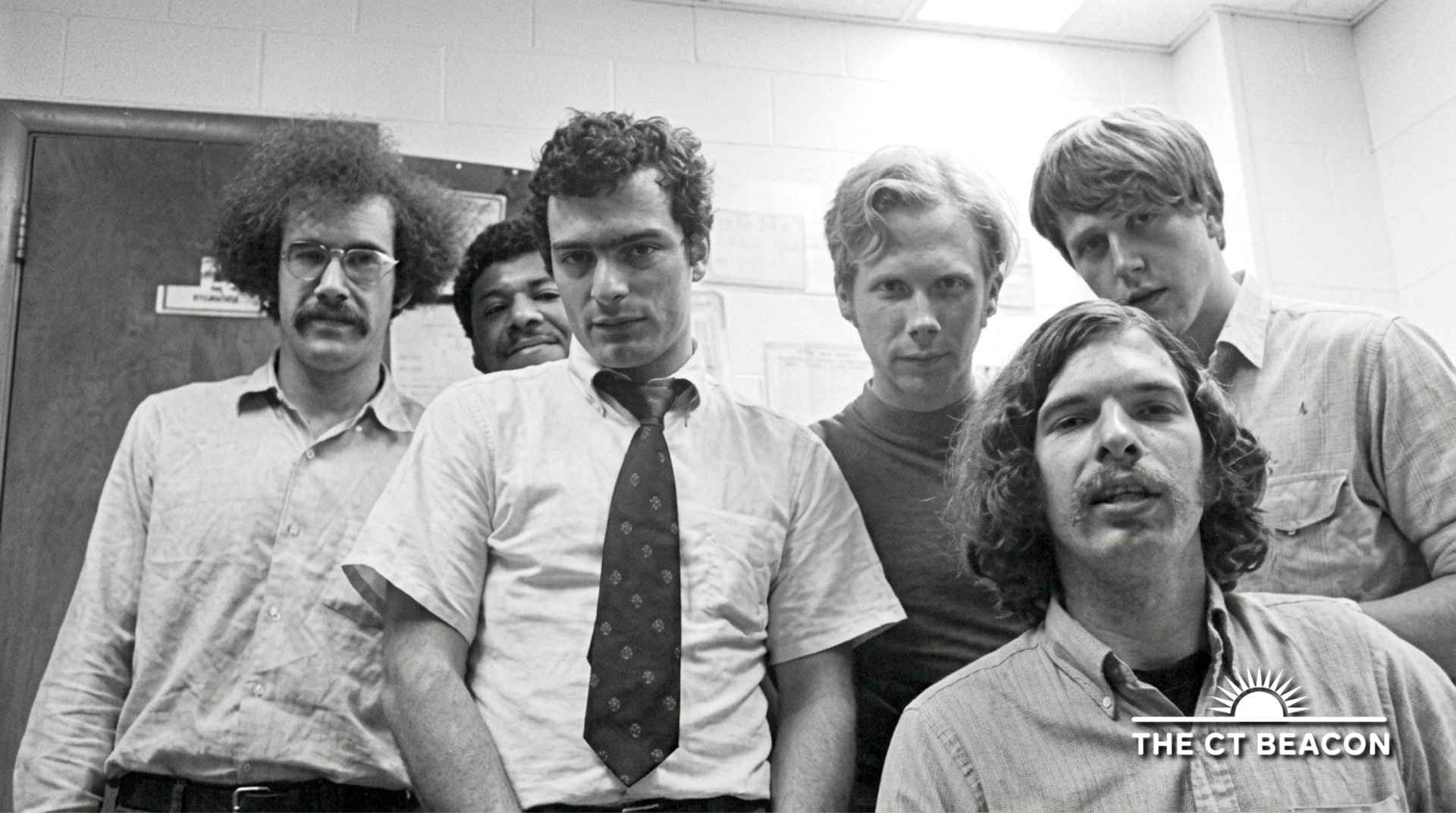
The Airwaves Belonged to the People: WBCN and the American Revolution brings the remarkable story of a Boston FM station that became part radio experiment, part rock & roll clubhouse, and part countercultural information network to United Theatre in Westerly for a one-night screening Thursday, September 10, at 6 p.m.
Long before podcasts, social media or the internet gave practically anyone a platform, WBCN challenged the idea of what a radio station was supposed to be. Its DJs chose their own records. Its news department covered movements and stories mainstream broadcasters often ignored. Its microphones captured everyone from activists and political figures to young musicians on the verge of becoming famous.
Director Bill Lichtenstein knows that world from the inside. He joined WBCN as a 14-year-old volunteer in 1970 and eventually worked at the station for years. His two-hour documentary uses a vast archive of recordings, photographs, and film to reconstruct the period when WBCN found itself at the intersection of music, Vietnam, Watergate, civil rights, women’s liberation, LGBTQ rights, and a generation questioning nearly every institution around it.
Before WBCN, There Was the Boston Tea Party
The story really begins with a music venue.
In 1967, Ray Riepen opened the Boston Tea Party, which quickly became one of the centers of Boston’s emerging underground music scene. For only a few dollars, audiences could encounter bands that would soon become enormously important, including The Who, the Velvet Underground and Led Zeppelin during its first American tour.
Riepen saw something happening around him that wasn’t being reflected on Boston radio.
On March 15, 1968, WBCN changed formats from classical music to free-form progressive rock. Instead of programmers in an office determining precisely which records would be played and when, the people behind the microphones were given extraordinary freedom.
Album tracks could replace three-minute singles. A DJ could follow Aretha Franklin with Cream or Frank Zappa’s Mothers of Invention. Announcers didn’t have to pretend they had no opinions about Vietnam, drugs, politics or the cultural upheaval happening outside the studio.
Music, news and politics began bleeding into one another.
The station became a place where listeners weren’t simply consuming programming. They were joining a community.
The Radio Station Became Part of the Revolution
WBCN didn’t merely report on Boston’s counterculture from a comfortable distance.
It was inside it.
The documentary places the station against the larger upheaval of the late 1960s and early ’70s: the Vietnam War and draft, anti-war demonstrations, clashes between police and protesters, civil rights activism, the emerging women’s and LGBTQ liberation movements and eventually the political crisis surrounding Richard Nixon and Watergate.
WBCN gave airtime to people and movements that received little or hostile treatment elsewhere in mainstream media.
It also developed an unconventional news operation.
Danny Schechter became the station’s “News Dissector,” while other members of WBCN’s staff blurred the traditional boundaries separating broadcasters from their audience. A Listener Line allowed people to call the station with questions and information around the clock.
For young listeners accustomed to the polished authority of network television and AM radio, WBCN sounded radically different.
Bruce Springsteen Called His Mother
The politics are only half the story.
WBCN existed during an extraordinary period in rock history, and Lichtenstein’s archive captures artists before some of them became icons.
The film includes Bruce Springsteen’s first radio interview and live in-studio performance in 1973. During that early appearance, the future superstar was still unknown enough to use his moment on Boston radio to say hello to his mother.
There’s also Patti Smith’s first radio concert in 1975, along with rare archival appearances involving David Bowie, Lou Reed, Jerry Garcia and others. Jane Fonda and activist Abbie Hoffman appear in the archive as well.
That’s one of the documentary’s strengths as a time capsule.
The audience knows what happened afterward.
Springsteen became Springsteen. Bowie became Bowie. Patti Smith became one of punk’s defining figures. But the recordings preserve moments when careers and movements were still unfolding and nobody in the room knew exactly where they were headed.
The DJs Didn’t Have a Playlist
Perhaps the hardest thing to explain to someone who grew up with tightly programmed commercial radio is just how unusual WBCN’s approach was.
There was no predetermined playlist dictating every record.
The announcers were personalities because they were actually allowed to have personalities. They could select music, talk about it, discuss politics and respond to what was happening around Boston.
Charles Laquidara became one of WBCN’s defining voices. Other station figures included J.J. Jackson, Tommy Hadges, Sam Kopper, Marsha Steinberg and Schechter.
The freedom produced radio that could be unpredictable, messy, deeply personal and occasionally confrontational.
It also created the possibility of discovery.
A listener didn’t already have to know which song they wanted to hear. The person on the other side of the radio could surprise them.
Lichtenstein’s companion history of WBCN describes the period from 1968 through Watergate as one in which the station became a hub connecting rock music, psychedelia and anti-war politics in Boston.
Bill Lichtenstein Was 14 When He Joined the Station
This isn’t a filmmaker reconstructing a culture he encountered decades later.
Bill Lichtenstein was part of it.
He began at WBCN in 1970 as a 14-year-old volunteer working the Listener Line. He eventually became an announcer and remained at the station into the 1970s before building a career as a journalist and documentary producer.
His work has earned a Peabody Award and dozens of journalism honors, and his writing has appeared in publications including The New York Times, The Nation, The Village Voice and The Boston Globe.
Lichtenstein eventually spent years assembling WBCN’s history from the people and material that survived it.
The documentary draws on rare archival audio and visual material alongside interviews with the people who were there. The story was also expanded into Lichtenstein’s 304-page book WBCN and the American Revolution: How a Radio Station Defined Politics, Counterculture, and Rock and Roll, published by MIT Press in 2021.
The Movie Has Returned With a New Title
Some viewers may recognize this film under a shorter name.
Lichtenstein’s documentary originally circulated as WBCN and the American Revolution, winning the DC Independent Film Festival and later airing nationally on PBS.
In 2026, it returned to theaters under the expanded title The Airwaves Belonged to the People: WBCN and the American Revolution.
The new theatrical release runs approximately 119 minutes and reframes the film for another moment when questions about who controls information, which voices get heard and what responsibilities media organizations have to the public have returned to the center of American life.
That makes this more than a documentary about old radio.
It’s an examination of an idea about media that now seems almost radical again: that the public airwaves were a public resource, and that a broadcaster could treat its listeners as participants rather than an audience to be packaged and sold.
When Radio Could Create a Community
WBCN itself didn’t remain the station depicted in the documentary forever.
Free-form FM grew into big business. Progressive rock radio became commercial rock radio. Corporate ownership expanded, playlists tightened and the industry that had once allowed a collection of young broadcasters to experiment eventually became much more structured.
But for a period beginning in 1968, WBCN demonstrated something unusual.
A radio station could introduce someone to a band, tell them what was happening at an anti-war demonstration, put an activist on the air, take a phone call from a listener and create the feeling that everyone tuned to the same frequency belonged to something happening in real time.
That’s what makes a two-hour documentary about a defunct Boston radio station potentially interesting even to someone who never heard WBCN.
The technology is obsolete.
The argument about what media is for isn’t.
Details
Event: The Airwaves Belonged to the People: WBCN and the American Revolution
Date: Thursday, September 10, 2026
Time: 6 p.m.
Runtime: Approximately 120 minutes
Director: Bill Lichtenstein
Genre: Documentary / Music / Media History
Venue: UNITED Main Cinema
Address: 5 Canal Street, Westerly, RI 02891
Format: Special one-night-only screening
Accessibility: The UNITED’s cinemas are wheelchair accessible; audio amplification, descriptive audio and closed-captioning devices are available for supported screenings
Ticket Policy: Movie and event tickets are non-refundable and non-transferable
Box Office: 401-388-8208
More information is available at the Event Website link below.
To purchase tickets, click the Event Ticketing link below.
Featured image is an artistic representation inspired by the event and may not depict the actual people, location, or activities shown.