


- This event has passed.
Polymer Clay Fashion Jewelry Making Workshop
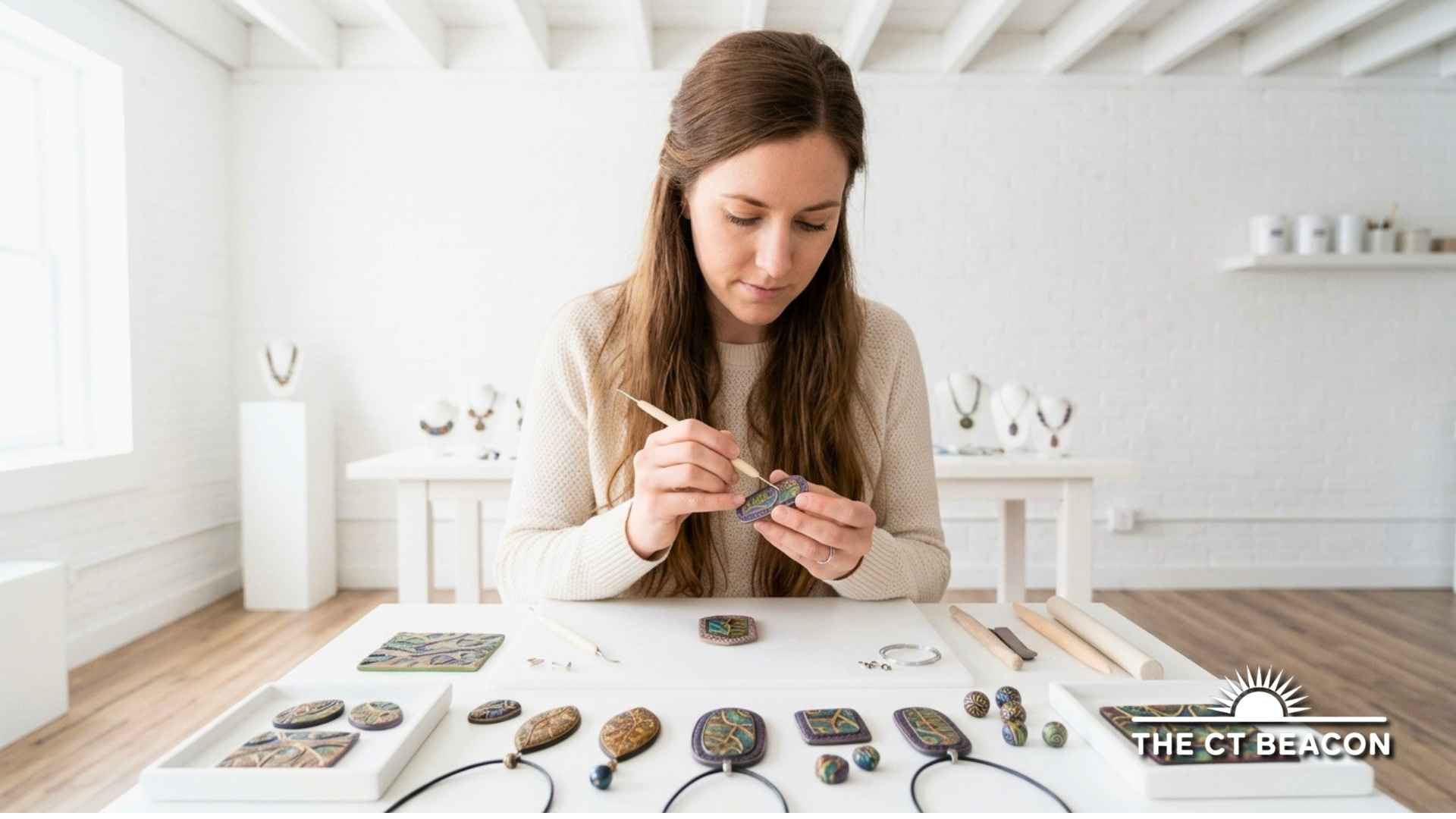
Polymer Clay Fashion Jewelry Making Workshop turns the jewelry people wear into the artwork they make Saturday, September 12, at Mystic Museum of Art.
Led by artist-educator Carol Mann, the three-hour hands-on workshop introduces participants to polymer clay through techniques including gilding, imprinting, stamping, inclusions, and cane making. Along the way, students will experiment with color, pattern, and texture before learning the finishing techniques and jewelry findings needed to turn their creations into wearable pieces.
The workshop runs from 10 a.m. to 1 p.m. and is part of the programming surrounding MMoA’s summer exhibition, LUXE CT: Velvet Mills to Modern Runways.
Polymer Clay Is Not the Clay You Remember From Art Class
Despite the name, polymer clay isn’t geological clay dug from the earth.
It’s a moldable synthetic material that remains workable until it is cured with heat. That makes it particularly useful for small-scale decorative work. Artists can roll it, layer it, texture it, stamp it and combine colors before curing the finished design.
For jewelry makers, that flexibility opens up an enormous range of possibilities.
A piece can mimic stone or other materials. Colors can be layered into patterns that continue through the clay. Metallic elements can be applied to surfaces. Texture can be pressed directly into a piece. Different components can then become earrings, pendants, beads or other wearable objects.
Saturday’s workshop is designed to introduce several of those approaches rather than concentrate on a single project.
From Gilding to Millefleur Canes
Among the techniques Mann will introduce is gilding, which can give polymer clay a metallic surface or accent.
Participants will also work with inclusions, adding other materials to clay to change its visual appearance, and experiment with imprinting and stamping to create surface textures and patterns.
One of the more distinctive techniques is cane making.
A polymer-clay cane is constructed so a design runs through the length of a cylinder or other shape. When thin slices are cut from it, the pattern appears repeatedly.
The concept has a long decorative-art relative in millefiori glass, the centuries-old technique associated particularly with Venetian glassmaking in which patterned glass rods are sliced to reveal repeated designs.
Polymer clay allows artists to explore a similar principle without a glass furnace.
The museum describes the workshop as including “millefleur canes,” giving participants an opportunity to see how a complex-looking decorative pattern can actually be built from relatively simple components.
The Final Step Turns Art Into Something Wearable
Creating the decorative clay is only part of the process.
Mann will also cover basic finishing and the use of jewelry findings, the small functional components that allow an artistic object to become jewelry.
Depending on the piece, findings can include hooks, posts, jump rings, clasps, pins and other hardware connecting decorative elements to something that can actually be worn.
That’s an important distinction in a workshop connected to an exhibition about textiles and fashion.
The finished work isn’t simply a miniature sculpture.
It becomes part of what someone wears.
The Workshop Comes Directly Out of LUXE CT
The timing isn’t accidental.
LUXE CT: Velvet Mills to Modern Runways is Mystic Museum of Art’s major summer 2026 exhibition, running from June 26 through October 11.
The exhibition looks at textiles in Connecticut from the precolonial period through contemporary fashion, using southeastern Connecticut’s once-significant velvet industry as one of its starting points.
But the show isn’t simply about fabric.
It’s about what people make, how they make it, who performs the labor and how materials can communicate wealth, identity, culture and changing ideas about luxury.
Objects in the exhibition include beadwork, embroidery, quilts, velvet and fashion, combining historical material with contemporary work.
MMoA assembled the exhibition in partnership with Historic Stonington, Mashantucket Pequot Museum & Research Center, Mystic Seaport Museum and members of Studio Art Quilt Associates’ Connecticut Region.
From Southeastern Connecticut Mills to Contemporary Fashion
One of the strengths of LUXE CT is the distance it covers.
Textiles that might once have been understood primarily as household objects or industrial products are placed in conversation with contemporary fashion.
That gives the exhibition room to explore something as seemingly simple as a piece of fabric from several directions.
Who made it?
Where did the material come from?
Was it produced by hand or in a mill?
Was it utilitarian or luxurious?
What did the design communicate about the person or community that created it?
And who decided it was valuable?
Those questions become particularly interesting in southeastern Connecticut, where textile production once provided jobs to generations of workers and immigrant families.
The exhibition connects those histories of labor and industrial production with cultural traditions that long predate the mills.
Connecticut Fashion Doesn’t End With the Mills
The exhibition then carries the story into contemporary fashion through designers with Connecticut connections.
Among them is Christian Siriano, who grew up in nearby Annapolis, Maryland, attended the American InterContinental University in London and became nationally known after winning Project Runway in 2008. His fashion house has since dressed figures ranging from actors and musicians to political leaders, while Siriano has become particularly known for challenging the fashion industry’s restrictive approach to body size and inclusivity.
Also represented is New York-based designer Peter Som, whose Connecticut connections are part of the exhibition’s contemporary story and whose career has included his own collections as well as work across fashion, lifestyle and design.
The exhibition also features emerging designers Xarea Lockhart and Toriana Sauro, giving visitors a look at how a new generation is thinking about clothing, materials and identity.
Together, the historic and contemporary pieces make the case that fashion doesn’t sit apart from history.
It records it.
A Series of Workshops Turns the Exhibition Into a Studio
The polymer clay session is part of a larger series of LUXE CT-inspired workshops running alongside the exhibition.
On September 19, the museum turns to felt collage.
September 26 brings an introduction to sewing workshop with featured designer Toriana Sauro.
Young artists ages 10 to 14 can explore embroidery September 27.
October workshops move into marbled textile sketchbook covers, relief printing on silk scarves and linocut printing on T-shirts.
The idea is a useful one: after seeing what generations of artists, craftspeople, textile workers and designers have done with materials, visitors can go upstairs to the studio and start manipulating materials themselves.
Saturday’s jewelry workshop provides one of the most approachable entry points.
No kiln, metalsmithing bench or previous jewelry-making career is required.
Carol Mann Leads the Workshop
Artist educator Carol Mann is a familiar instructor within Mystic Museum of Art’s studio program.
Her teaching at MMoA extends across media rather than being confined to jewelry. She leads courses in watercolor and mixed-media work and teaches younger artists as well, including classes that combine clay, fiber, paper and wax.
That teaching background is useful for a workshop built around experimentation.
Participants aren’t simply following instructions to reproduce one identical piece. The museum’s description emphasizes learning techniques and then combining color, texture and pattern into distinctive designs.
The goal is individual work.
If everyone leaves with exactly the same jewelry, something has probably gone wrong.
The Material Is Supplied, But There’s an Additional Fee
Participants don’t need to arrive with a jewelry-making toolbox.
Mystic Museum of Art says all materials are supplied for the workshop.
There is, however, an additional $8 materials fee, payable directly to the instructor. That’s separate from registration, which costs $60 for museum members and $70 for nonmembers.
It’s worth accounting for that when deciding whether to register: the actual total is $68 for members or $78 for nonmembers once the materials fee is included.
The workshop is listed as an adult studio program and runs for three hours.
You Can See the Exhibition That Inspired It
There’s also an opportunity to connect the studio experience directly to its source material.
LUXE CT: Velvet Mills to Modern Runways remains on view through October 11.
Special exhibition admission is $12 general admission and $10 for New London County residents, seniors 65 and older and students with ID. Admission is free for Mystic Museum of Art members, visitors 17 and younger and military members and veterans.
That means someone coming for Saturday’s workshop can approach the day from both directions.
Look at how other people have transformed fabric, thread, beads and other materials into objects carrying cultural and personal meaning.
Then sit down at a table and start making something.
The scale may be smaller.
The basic impulse isn’t very different.
Details
Event: Polymer Clay Fashion Jewelry Making Workshop: LUXE CT-Inspired Studio Workshop
Date: Saturday, September 12, 2026
Time: 10 a.m.–1 p.m.
Instructor: Artist educator Carol Mann
Venue: Mystic Museum of Art
Address: 9 Water Street, Mystic, CT 06355
Program: Adult studio workshop / mixed media / jewelry making
Member Registration: $60
Nonmember Registration: $70
Materials Fee: Additional $8, payable to the instructor
Materials: All materials are supplied
Techniques: Gilding, inclusions, imprinting, stamping, cane making, color and texture work, finishing and jewelry findings
Related Exhibition: LUXE CT: Velvet Mills to Modern Runways, on view through October 11
Museum Phone: 860-536-7601
More information is available at the Event Website link below.
To register for the workshop, click the Event Registration link below.
Featured image is an artistic representation inspired by the event and may not depict the actual people, location, or activities shown.