
Community Festival & Firemen’s Muster Celebrates America’s 250th in Pawcatuck
The Community Festival & Firemen’s Muster brings one of New England’s oldest firefighting traditions to Pawcatuck on Saturday, August 22, as antique hand-pumped fire engines and their crews compete alongside an afternoon of food, games, and family activities celebrating America’s 250th birthday.
Held from noon to 4 p.m. at Harley P. Chase VFW Post 1265, the festival gives visitors a chance to see something that has largely disappeared from everyday life: teams of competitors working antique fire engines by hand and attempting to send a stream of water farther than their rivals.
And some of the machines coming to Pawcatuck are nearly 200 years old.
The event combines the New England States Veteran Firemen’s League muster with an old-fashioned community celebration featuring hamburgers, hot dogs, popcorn, cotton candy, food, raffles, games and activities for children.
What Is a Firemen’s Muster?
Long before diesel engines, aerial ladders and modern pump trucks arrived at a fire, communities depended on machines commonly known today as hand tubs.
Teams of firefighters operated the pumps manually, forcing water through a hose while crews worked together to maintain enough pressure to fight a fire. Eventually, the equipment became the centerpiece of competitions between fire companies.
The basic idea is wonderfully simple: pump hard and throw water farther than everybody else.
Firemen’s musters have been held in New England since at least the mid-19th century. Historical accounts trace one of the earliest organized competitions to Bath, Maine, on July 4, 1849, when crews competed to see which hand-pumped engine could throw the longest stream of water.
The competitions became serious enough that disagreements over rules eventually became a problem.
In November 1890, representatives gathered at the Boston Veteran Fireman’s Association headquarters on Washington Street in Boston. Until then, judges at individual musters could establish rules at the field, creating confusion and disputes between competing organizations.
The meeting resulted in the creation of the New England States Veteran Firemen’s League, establishing common rules while working to preserve what its founders described as the country’s oldest sport.
The league’s first championship followed in Lowell, Massachusetts, on September 23, 1891. Seventeen engines competed, with Volunteer No. 4 of Central Falls, Rhode Island, winning after throwing a stream 209 feet, 1 inch. The competitions were originally held during the week because crews relied on trains to transport their engines. As motor vehicles became more common, the championship moved to weekends.
More than 130 years later, they’re still doing it.
Antique Fire Engines Coming to Pawcatuck
The August 22 Pawcatuck muster is sanctioned by the New England States Veteran Firemen’s League, with pumping scheduled to begin at noon at 160 South Broad Street.
Seven antique engines are currently listed to compete, representing communities from across New England.
T.W. Lane — Mystic, Connecticut
Built by Button in 1883, the hometown entry gives southeastern Connecticut someone to root for. T.W. Lane remains an active competitor: at a 2025 muster in Bath, Maine, it recorded a stream of 176 feet, 10½ inches.
Union No. 1 — Southborough, Massachusetts
A Hunneman engine dating to 1867.
Hancock No. 128 — Ashburnham, Massachusetts
The oldest scheduled competitor in Pawcatuck is a Hunneman engine built in 1828. Yes, 1828. The machine predates the Civil War by more than three decades and is still being brought out for competition nearly two centuries after it was built.
Rescue — Bath, Maine
This Howard & Davis machine dates to 1852 and comes from the Maine community with one of the country’s longest-running hand-tub traditions.
Tiger No. 1 — Newmarket, New Hampshire
Built by Leslie in 1852.
Protection No. 1 — Newbury, Massachusetts
A Jeffers machine built in 1865. Protection No. 1 is also a formidable competitor. At the 2025 New England States Veteran Firemen’s League muster in Salisbury, Massachusetts, it threw water 217 feet, 10¼ inches.
Quansigamog — Bath, Maine
Another survivor from the middle of the 19th century, this Hunneman engine was built in 1853.
That means spectators won’t simply be looking at antique firefighting equipment sitting behind ropes. They’ll see machines built between 1828 and 1883 actually being operated in competition.
How the Competition Works
The objective remains remarkably close to what firefighters were doing generations ago.
Crews work the engine’s pumping mechanism to build pressure and send water through the nozzle. The resulting stream is measured for distance, with competitors divided into classes based on the size of the engine’s cylinders.
And these old machines can move some serious water.
Modern league results routinely show streams traveling well beyond 150 feet, while winning performances can break the 200-foot mark. At Salisbury’s 2025 competition, Protection No. 1’s 217-foot-plus performance took first place in its class.
Prize money is also on the line in Pawcatuck. The published 2026 scorecard lists prizes in both classes ranging from $200 for first place to $75 for sixth place.
A Community Celebration of America’s 250th
The muster is the centerpiece, but organizers are building an afternoon around it to mark the country’s semiquincentennial.
Families can spend the afternoon watching the competition while enjoying hamburgers, hot dogs, popcorn, cotton candy and other food, along with raffles, games and children’s activities.
The combination actually fits the history nicely. Musters weren’t created as quiet museum demonstrations. They developed as community gatherings and competitions, complete with hometown pride and spectators watching local fire companies challenge crews from neighboring towns.
Pawcatuck is essentially bringing that atmosphere into 2026.
The Story Behind Harley P. Chase VFW Post 1265
Even the location has a history worth knowing.
Harley P. Chase Post 1265 was formally instituted in Pawcatuck on November 16, 1924, with 86 charter members. The ceremony at the Central Theater was preceded by a parade through Pawcatuck. The organization eventually moved to its current home at 160 South Broad Street in July 1973.
The post was named for Harley Philip Chase, a Westerly native born December 11, 1895.
Before the United States entered World War I, Chase worked as a letter carrier at the Westerly Post Office. He entered military service in May 1918 and became a private first class with Company E of the 314th Infantry Regiment, 79th Infantry Division.
Only four months later, Chase was killed in action in France on September 26, 1918, at age 22. According to the history compiled by VFW Post 1265, Chase was the first native-born Westerly resident killed during World War I. His name appears with a gold star on Westerly’s World War I memorial, and he is buried at River Bend Cemetery in Westerly.
More than a century later, the Pawcatuck VFW post bearing his name remains part of the community.
Event Details
Date: Saturday, August 22, 2026
Time: Noon–4 p.m.
Muster begins: Noon
Location: Harley P. Chase VFW Post 1265
Address: 160 South Broad Street, Pawcatuck, CT 06379
Activities: New England firemen’s muster, antique hand-pumped fire engines, children’s activities, games and raffles
Food: Hamburgers, hot dogs, popcorn, cotton candy and more
The muster currently lists seven competing antique engines from Connecticut, Massachusetts, New Hampshire and Maine. Because the published scorecard is set up to record results on the day of competition, the final standings and distances won’t be known until the pumping is complete.
More information about the firemen’s muster is available at the New England States Veteran Firemen’s League website.
New England States Veteran Firemen’s League
More information about Harley P. Chase VFW Post 1265 is available at the post’s website:
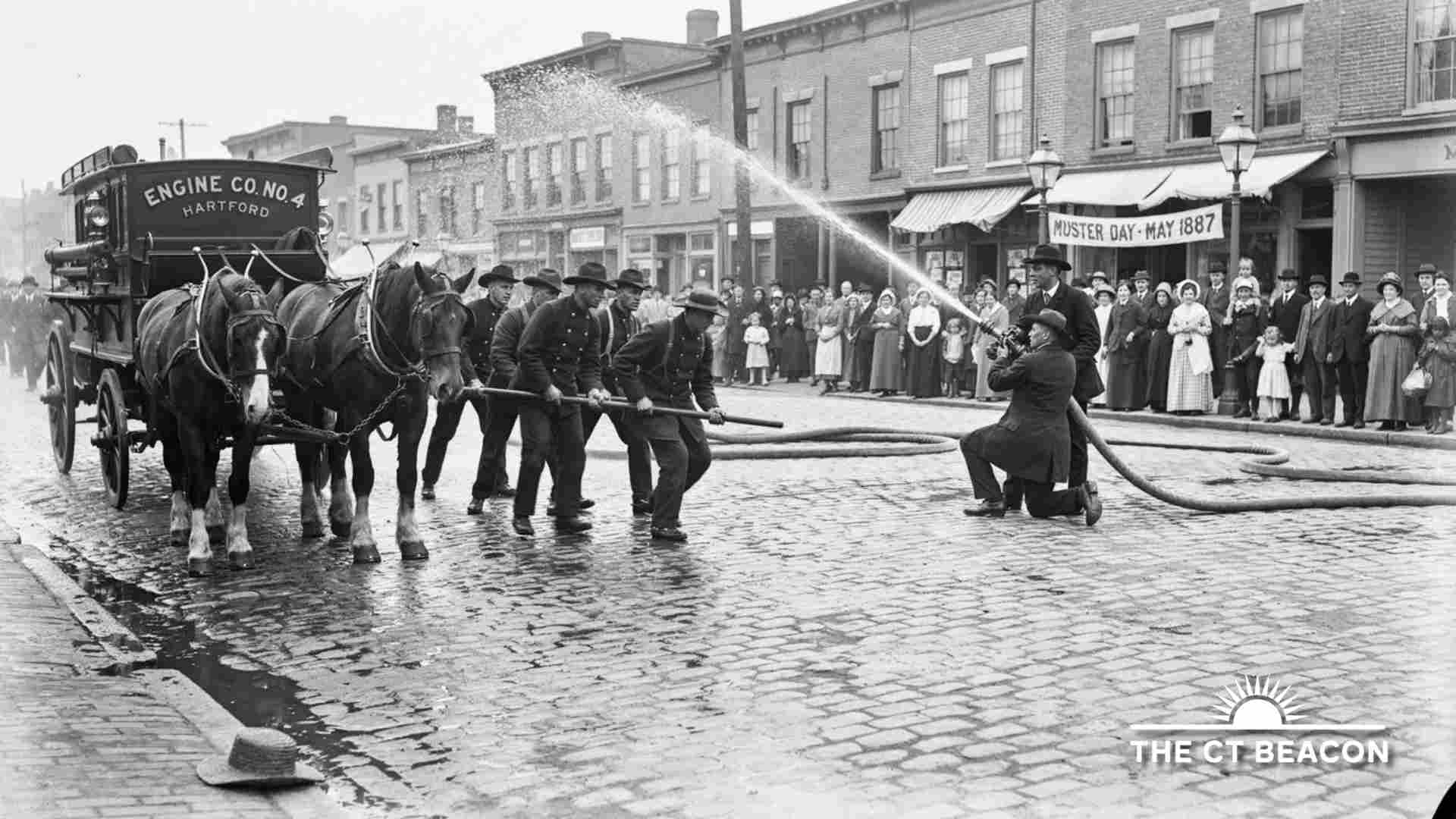
[ The featured image above is of a late-19th-century New England firemen’s muster, when fire companies competed using the hand-operated equipment of the era. The tradition continues in Pawcatuck on August 22.]