


Swing Band Benefit Concert Brings Three Big Bands and a Dance Floor to the UNITED
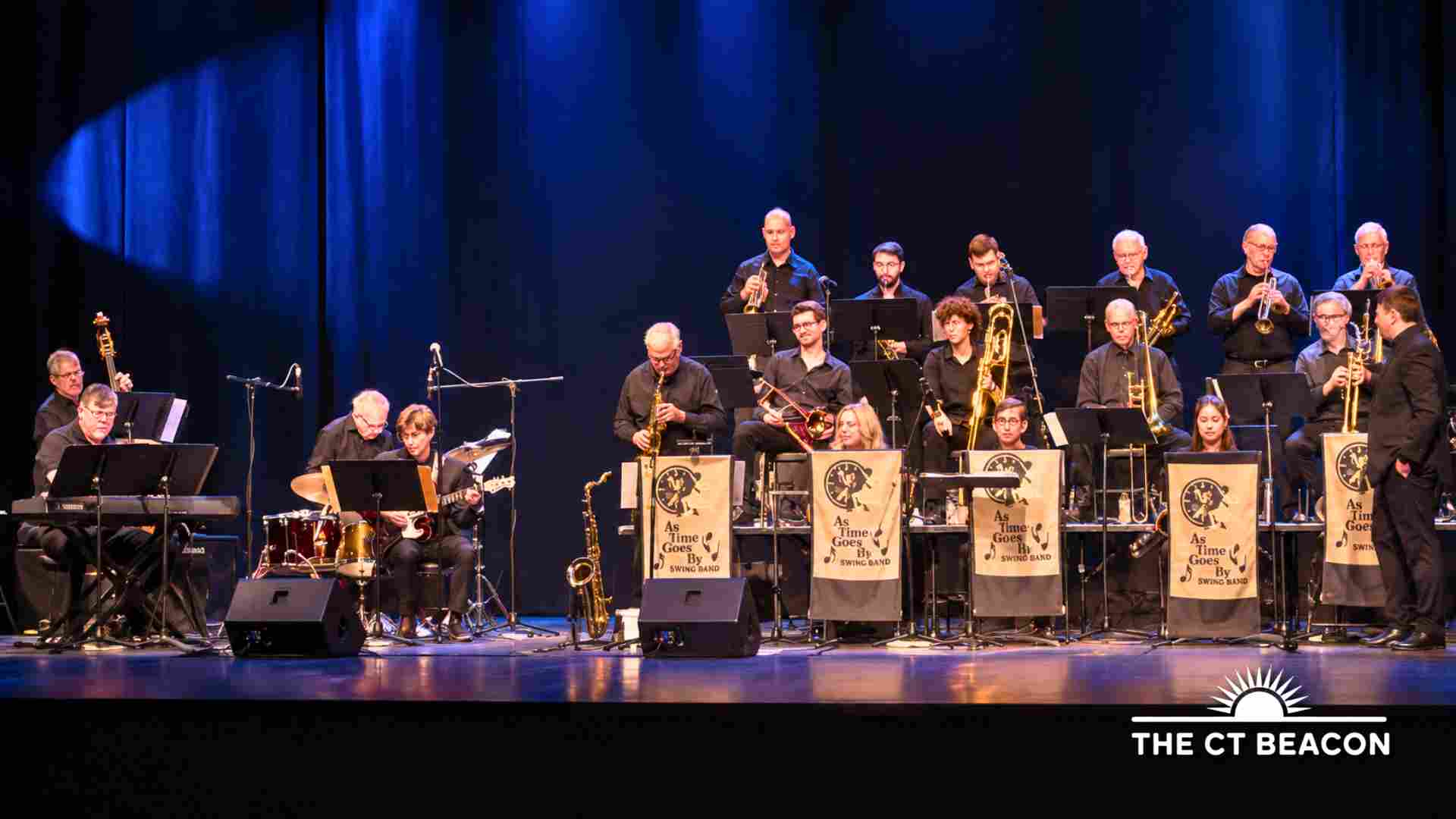
Swing Band Benefit Concert fills the UNITED Theatre with brass, reeds, rhythm and the music of the big-band era on Sunday, September 20, as three regional jazz orchestras share the stage for a concert benefiting music education on both sides of the Connecticut-Rhode Island line.
The third annual benefit runs from 5 to 7 p.m. in the UNITED’s Black Box Auditorium in Westerly. This year’s lineup brings together the Time and Changes Jazz Orchestra, As Time Goes By and the Sean Nelson Jazz Orchestra.
The music reaches back to Frank Sinatra, Benny Goodman, Glenn Miller and Count Basie, but this isn’t being presented as a sit-down history lesson.
The UNITED’s invitation is considerably simpler: listen, dance, and donate.
And the money raised goes back into music, supporting the UNITED Music School and music programs in the Westerly and New London public schools.
Three Bands, One Concert
The structure gives the evening something closer to a miniature big-band festival than a conventional concert.
Time and Changes Jazz Orchestra opens the show.
The group performs in the classic 17-piece big-band configuration, the kind of lineup capable of producing the enormous ensemble sound associated with the swing era.
Next comes As Time Goes By, a local swing and jazz band that also organized the benefit.
Then the Sean Nelson Jazz Orchestra closes the evening with another 17-piece ensemble drawing musicians from around New England.
Put all three together and there will be a lot of musicians moving through the UNITED stage in two hours.
That’s appropriate for music that was built around scale.
Why 17 Musicians?
There’s a reason two of Sunday’s ensembles are specifically described as 17-piece bands.
The classic big-band format generally divides its musicians into sections: saxophones, trumpets, trombones and a rhythm section.
Rather than simply having everyone play simultaneously, arrangers can move melodies and harmonies among those sections.
Saxophones can carry one passage before trumpets answer.
Trombones can add a darker layer underneath them.
The rhythm section keeps everything moving while individual musicians step forward for solos.
Then the arranger can bring the entire ensemble together.
That’s where the sheer power of a big band comes from.
A 17-piece jazz orchestra can whisper, but when everybody arrives at the same musical destination at once, it doesn’t stay quiet for long.
Time and Changes Opens With the Classic Big-Band Sound
The Time and Changes Jazz Orchestra gets first crack at the room.
Its billing as a classic 17-piece big band immediately establishes the musical vocabulary for the evening.
This is music descended from the large jazz orchestras that became one of America’s dominant forms of popular entertainment during the 1930s and ’40s.
Before rock bands filled arenas, big bands filled ballrooms.
And before recorded music became the default soundtrack for a night out, people danced to actual orchestras.
That connection between jazz and dancing is important to Sunday’s concert because the UNITED isn’t asking audiences simply to admire the arrangements.
Dancing is part of the evening.
As Time Goes By Is the Band Behind the Benefit
The middle set belongs to As Time Goes By, the local swing and jazz group that organized the Swing Band Benefit Concert.
That gives the band’s appearance a different role.
They’re not simply one of three acts on the bill. They’re helping bring the bands together around a common purpose.
This is now the event’s third year, giving what began as a benefit concert the beginnings of an annual Westerly tradition.
As Time Goes By occupies the center position between two large jazz orchestras, creating some musical variety while keeping the evening rooted firmly in swing and jazz.
And its name couldn’t be much more appropriate for a concert drawing heavily from the American songbook.
Sean Nelson Jazz Orchestra Closes the Night
The final set belongs to the Sean Nelson Jazz Orchestra.
Like Time and Changes, Nelson’s group is a 17-piece jazz orchestra, with the UNITED describing its membership as musicians drawn from across New England.
Nelson is a trombonist, composer, arranger and bandleader whose work spans jazz performance and large-ensemble writing.
A jazz orchestra gives an arranger an unusually broad musical palette.
Instead of thinking only about melody, chords and rhythm, the arranger can work with instrumental color: which section carries a line, which instruments answer it, where the ensemble pulls back and when the entire band comes roaring in.
That’s part of what separates hearing this music from a recording.
A big band moves air.
In a live room, you feel the brass as much as hear it.
Sinatra, Goodman, Miller and Basie Point Toward the Songbook
The UNITED is highlighting music associated with Frank Sinatra, Benny Goodman, Glenn Miller and Count Basie.
Those four names cover a surprising amount of musical territory.
Goodman’s orchestra helped push swing into the center of American popular culture during the 1930s.
Miller developed one of the era’s most recognizable ensemble sounds, producing recordings that became inseparable from the World War II generation.
Basie’s orchestra approached swing differently, with an extraordinary emphasis on rhythm, space and blues.
And Sinatra’s career connected the big-band era with the emergence of the modern solo pop vocalist.
He first became a national star singing with the Harry James and Tommy Dorsey orchestras before establishing the solo career that eventually made him one of the defining American singers of the 20th century.
Sunday’s program isn’t advertised as a recreation of one specific orchestra or period.
Instead, those names provide the musical coordinates.
This Music Was Made for Dancing
Big-band jazz eventually became something people often encountered in concert halls, jazz festivals and record collections.
That can obscure its original function.
People danced to it.
Swing developed alongside an enormous social-dance culture, and the relationship between dancers and musicians influenced the music itself.
The rhythm had to move.
Tempos mattered.
Arrangements needed momentum.
A packed dance floor wasn’t a distraction from the orchestra. It was evidence that the orchestra was doing its job.
That’s why the UNITED’s “come listen, dance and donate” description is more than a catchy invitation.
Dancing puts this music back into something resembling its original environment.
Nobody has to dance, of course.
But the opportunity is there for anyone who hears a Basie-style rhythm section and finds sitting still increasingly difficult.
The Benefit Looks Forward While the Music Looks Back
The most important part of the concert may be what happens after the final note.
Proceeds from the 2026 event benefit the UNITED Music School, along with music programs in the Westerly and New London public schools.
That gives the evening a nice symmetry.
Professional and experienced regional musicians are performing music with roots stretching back nearly a century to help younger musicians get access to instruments, instruction and school music programs now.
The UNITED Music School operates as part of the theater’s broader educational mission, offering music instruction and performance opportunities from its downtown Westerly campus.
Supporting public-school programs extends the impact beyond the theater itself.
And notably, the beneficiaries cross the state line.
Westerly is in Rhode Island.
New London is in Connecticut.
Music doesn’t care much about the border.
The UNITED Is an Appropriate Home for It
The setting also carries its own musical history.
The UNITED originally opened as a vaudeville theater in 1926, placing its beginnings just before the big-band era exploded nationally.
After decades as a movie theater and a long period of closure, the building was extensively redeveloped and reopened in 2021 as a multidisciplinary arts center.
Today it combines cinemas, live-performance spaces and a music school under one roof.
Sunday’s concert brings all of those strands together particularly well.
It’s a live performance of music rooted in the first half of the 20th century, presented inside a restored 1920s theater, raising money to teach musicians who will carry music into the future.
Two Hours, Three Bands and a Lot of Horns
There are easier ways to raise money.
You can hold a raffle.
You can sell baked goods.
Or you can put three swing bands onstage, assemble dozens of musicians, clear some room for dancing and let Count Basie, Glenn Miller, Benny Goodman and Sinatra provide the inspiration.
The Swing Band Benefit Concert has chosen the latter.
For anyone who loves the sound of a full horn section, Sunday evening should provide plenty of it.
And every ticket helps make sure another generation gets the chance to learn how to make some noise of its own.
Details
Event: Swing Band Benefit Concert
Date: Sunday, September 20, 2026
Time: 5–7 p.m.
Location: UNITED Theatre, Black Box Auditorium
Address: 5 Canal Street, Westerly, RI 02891
Performers: Time and Changes Jazz Orchestra, As Time Goes By and Sean Nelson Jazz Orchestra
Music: Big band, swing and jazz, including selections associated with Frank Sinatra, Benny Goodman, Glenn Miller and Count Basie
Adult Tickets: $22
Under 18: $12
Beneficiaries: UNITED Music School and music programs in the Westerly and New London public schools
Dancing: Encouraged
Phone: 401-388-8208
Email: info@unitedtheatre.org
Accessibility: The UNITED’s cinemas are wheelchair accessible. The theater recommends contacting the box office before purchasing live-performance tickets to discuss the best accessible seating location. Assistive listening devices are also available.
Ticket Policy: UNITED event tickets are non-refundable and non-transferable.
More information is available at the Event Website link below.
To purchase tickets, click the Event Ticketing link below.
Featured image is an artistic representation inspired by the event and may not depict the actual people, location, or activities shown.