


- This event has passed.
Mystic Dead at the Charlestown Rathskeller
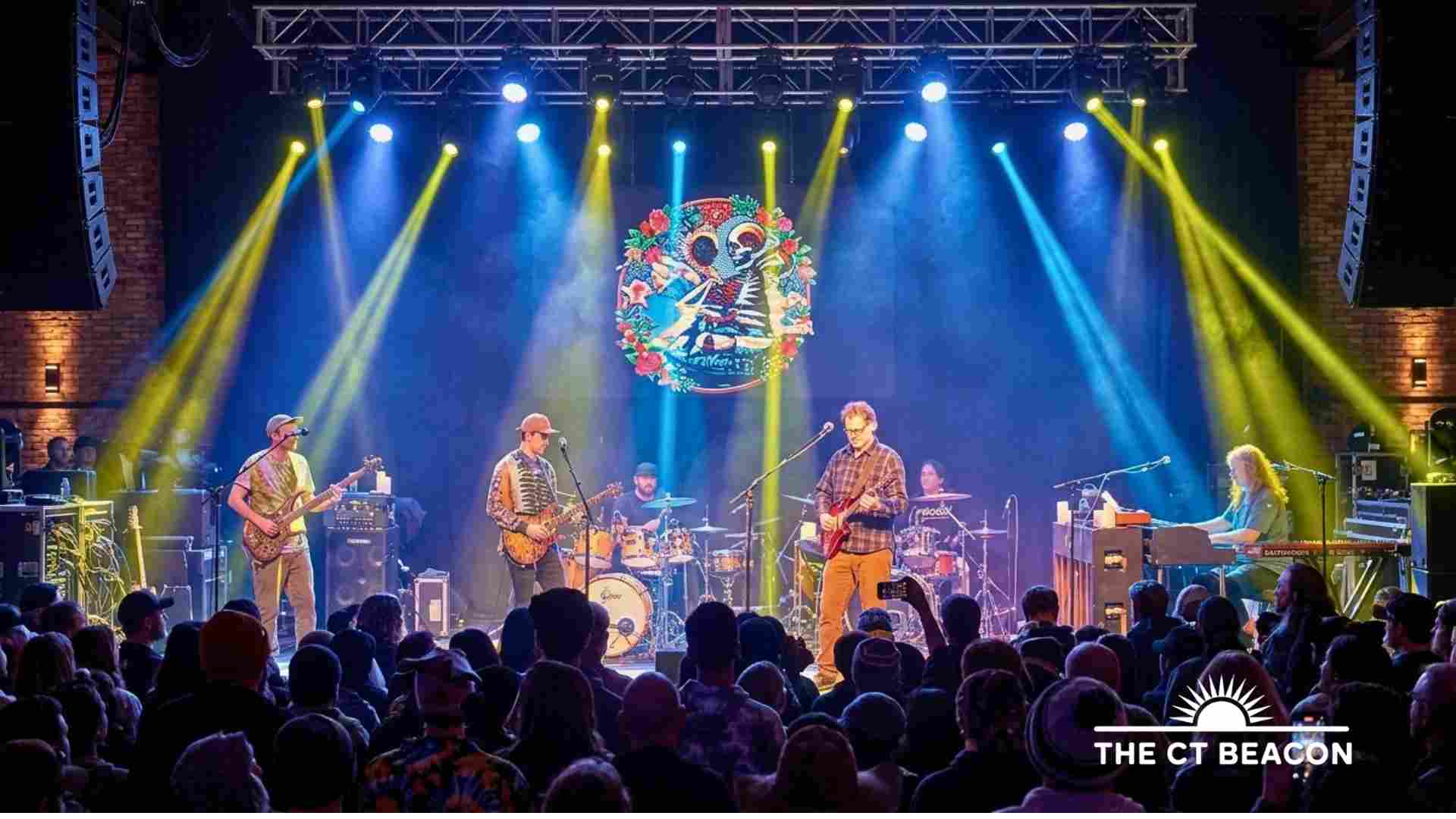
Mystic Dead at the Charlestown Rathskeller brings the music of the Grateful Dead to the woods of Charlestown on Friday, September 4, with three hours of extended jams, improvisation, and songs drawn from one of rock’s deepest catalogs.
The southeastern Connecticut-based six-piece performs from 8 to 11 p.m. at the Rathskeller, continuing a relationship with the venue that has already brought Mystic Dead to Charlestown multiple times in 2026.
Tickets are $15 in advance, plus fees, and $20 at the door.
For a band that began with a once-a-month Dead night in Mystic, it’s another stop in what has become a much bigger trip.
It Started With a Dead Night in Mystic
Mystic Dead wasn’t created as a touring tribute act with a business plan.
In 2018, a group of local musicians began getting together once a month to play Grateful Dead music at the Captain Daniel Packer Inne in Mystic.
It was supposed to be a Dead night.
Then people kept coming.
The musicians kept playing.
And Mystic Dead was born.
The six-piece band has since moved well beyond its Mystic beginnings, playing clubs, theaters, breweries, festivals and outdoor venues throughout Connecticut and Rhode Island.
But the approach established during those early nights remains central to the band.
Mystic Dead doesn’t simply reproduce a list of Grateful Dead songs.
It uses them as somewhere to go.
You Can’t Really Tribute the Dead Note for Note
There is a fundamental problem with trying to recreate a Grateful Dead concert.
The Grateful Dead didn’t recreate Grateful Dead concerts.
Songs changed from night to night. Set lists changed. Tempos shifted. One song could dissolve into another without a clean break. A familiar piece of music might suddenly become the launching point for a long improvisation that had never happened before and would never happen exactly the same way again.
That unpredictability became one of the defining characteristics of the band.
It also helped create Deadheads.
Fans didn’t simply want to hear “Truckin’,” “Sugaree,” “Scarlet Begonias” or “Eyes of the World” again. They wanted to hear what those songs might become tonight.
Mystic Dead takes that philosophy seriously.
The band describes its approach as a deep dive into the Grateful Dead catalog while allowing all six musicians the freedom to maintain their own creative individuality.
That’s an important distinction.
The goal isn’t to make every note sound exactly like a record made 50 years ago.
It’s to recreate the possibility that something unexpected can happen between the notes.
The Grateful Dead Built a Catalog Made for Exploration
The source material gives Mystic Dead plenty of room.
The Grateful Dead formed in the San Francisco Bay Area in 1965 and became inseparable from the counterculture developing around Haight-Ashbury.
But trying to assign the band a single genre has never worked particularly well.
Rock was there.
So were blues, folk, country, bluegrass, psychedelia, jazz and traditional American music.
Jerry Garcia, Bob Weir, Phil Lesh, Ron “Pigpen” McKernan and Bill Kreutzmann formed the original core, with Mickey Hart joining soon afterward. Personnel would change over the band’s 30-year run, but musical exploration remained constant.
A song could be tightly constructed one night and stretched far beyond its original boundaries on another.
That created a catalog particularly well suited to musicians who want to improvise rather than simply imitate.
The Set List Is Only the Beginning
A conventional tribute concert can work like a jukebox.
Recognize the opening notes.
Sing the chorus.
Wait for the next hit.
Grateful Dead music invites something different.
“Dark Star” became famous partly because its relatively simple structure could open into enormous stretches of improvisation.
“China Cat Sunflower” and “I Know You Rider” became so closely associated in concert that the transition between them became part of the experience.
“Scarlet Begonias” could flow into “Fire on the Mountain.”
“Help on the Way” could lead into “Slipknot!” and then “Franklin’s Tower.”
The space between songs could matter as much as the songs themselves.
That’s the territory a band like Mystic Dead gets to explore.
The destination may be familiar.
The route doesn’t have to be.
The Deadheads Changed Concert Culture Too
The Grateful Dead’s influence goes far beyond its recordings.
A traveling community grew around the band, with fans following tours from city to city and trading recordings of performances.
The Dead famously allowed fans to record concerts from designated taping areas, helping create an enormous archive of live performances that circulated among listeners.
That culture reinforced an idea that seems obvious now but was unusual at the time:
A concert didn’t have to be disposable.
One night’s version of a song could become something worth seeking out years later.
Fans compared performances, traded tapes and debated particular versions of songs.
The Grateful Dead became a band whose live history could be explored almost endlessly.
When Garcia died in 1995 and the Grateful Dead’s 30-year run ended, the music didn’t disappear with it.
Former members continued performing in different configurations. New generations discovered the recordings. Tribute bands emerged everywhere.
And eventually, six musicians started playing a monthly Dead night in Mystic.
Mystic Dead Doesn’t Stay in Mystic Anymore
By 2026, Mystic Dead’s calendar stretches well beyond its hometown.
The band has played throughout Connecticut and Rhode Island, with appearances this year at venues ranging from breweries and taverns to Infinity Music Hall in Norfolk.
September alone includes the Rathskeller show followed by appearances at StageOne in Fairfield, Mitchell Farm in Salem and Arch Street Tavern in Hartford.
That growth makes the band’s name a little deceptive.
Mystic is where it started.
It isn’t where it stayed.
Three Hours Down Back
The Charlestown Rathskeller is particularly well suited to this kind of show.
The historic tavern dates to 1933 and sits tucked into the woods along Old Coach Road, away from the busier coastal strips of South County.
Behind the restaurant is the Rathskeller’s seasonal outdoor entertainment area known as Down Back.
It’s a casual setting built for lingering rather than sitting silently through a performance. The grounds include outdoor seating, lawn games and a large fire pit, with live music running through the warmer months.
For Friday’s show, that means Mystic Dead has three hours to work with.
And three hours changes what a Grateful Dead tribute can do.
There’s room for the familiar songs.
There’s also room to let one wander.
The Song Doesn’t Have to End Where It Started
That’s ultimately the appeal of Mystic Dead.
The songs may have been written decades ago.
The performance isn’t.
A good Dead show has always depended on the musicians listening to one another, recognizing when something interesting is happening and being willing to follow it.
Sometimes the experiment lands.
Sometimes it wanders.
And sometimes a song everybody in the audience has heard hundreds of times suddenly finds a place none of them expected.
That’s why, nearly three decades after six musicians gathered for a monthly Dead night in Mystic, the Grateful Dead’s music still provides enough territory for another six musicians to explore.
On September 4, they’ll have three hours in the woods of Charlestown to see where it takes them.
Event Details
Event: Mystic Dead – Grateful Dead Tribute
Date: Friday, September 4, 2026
Time: 8–11 p.m.
Location: The Charlestown Rathskeller
Address: 489A Old Coach Road, Charlestown, RI 02813
Band: Mystic Dead
Music: Grateful Dead tribute / jam band
Advance Tickets: $15 plus Eventbrite fees
Door Tickets: $20
Venue: Outdoor live music at the Charlestown Rathskeller
More information is available at the Event Website link below.
To purchase tickets, click the Event Ticketing link below.
Featured image is an artistic representation inspired by the event and may not depict the actual people, location, or activities shown.