


- This event has passed.
Moth Ball at Denison Pequotsepos Nature Center
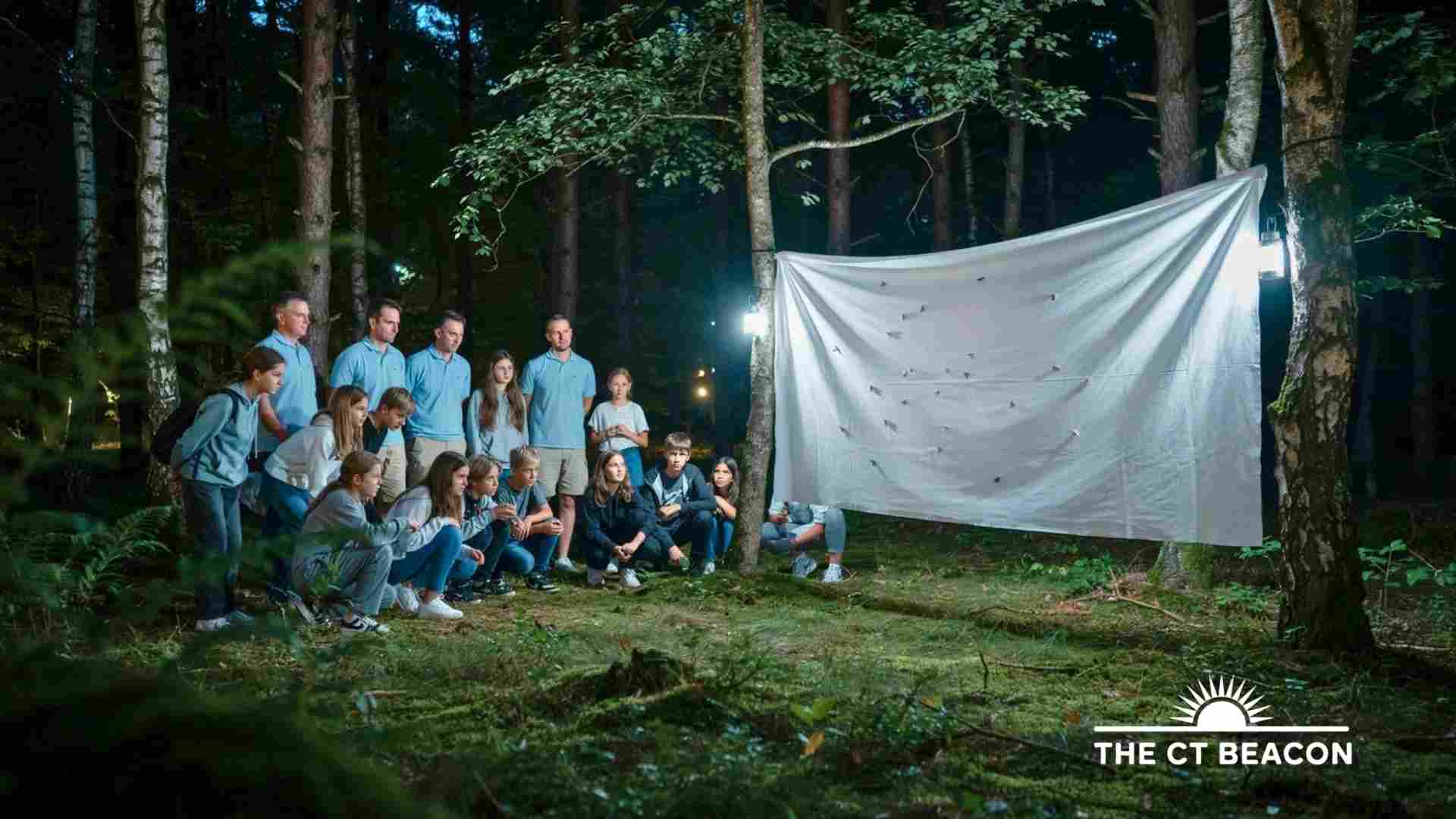
Moth Ball at Denison Pequotsepos Nature Center turns the lights on after dark Friday, September 4, for a hands-on look at the surprisingly diverse world of moths living around Mystic.
From 7:15 to 9:15 p.m., DPNC will set up illuminated sheets and wait to see what flies in. Participants won’t simply watch. They’ll help count and catalog the moths that arrive, take a nighttime nature walk and learn more about insects that spend much of their lives unnoticed by us.
And that’s part of the fun.
Nobody knows exactly who is coming to the Moth Ball.
Butterflies Get the Day Shift
Butterflies have a considerable public-relations advantage over moths.
They’re out when we are.
We see monarchs crossing a meadow, swallowtails visiting flowers and little skippers bouncing around the garden. We photograph them, plant gardens for them and generally agree that butterflies are among the insects we’re happy to have around.
Then the sun goes down.
That’s when an enormous part of the Lepidoptera world takes over.
Moths and butterflies belong to the same insect order, Lepidoptera, but moths account for the overwhelming majority of its species. And the little brown moth bouncing against the porch light represents only a tiny fraction of what they can look like.
Connecticut is home to moths that can be green, pink, orange, yellow or patterned with elaborate eyespots. Some are barely noticed. Others can be startlingly large.
Moth Ball is designed to find out which ones are flying around the Nature Center on one September night.
Turn On a Light and See Who Arrives
The setup is wonderfully simple.
DPNC will use custom light sheets to observe moths after dark.
A bright light illuminates a pale sheet, creating a large surface where visiting insects can land and be examined without disappearing against leaves, bark and the darkness surrounding them.
Then you wait.
Moths and other nocturnal insects begin arriving, turning a blank piece of fabric into a temporary field station.
Participants can get close enough to examine patterns, body shapes, antennae and other characteristics that would be nearly impossible to study while an insect is flying through the woods.
DPNC will use the evening as an actual hands-on survey, with visitors helping count and catalog what appears.
The night’s species list won’t be known until the moths write it themselves.
Why Do Moths Fly Toward Lights?
Everyone has seen it happen.
Turn on a porch light and sooner or later something starts circling it.
The familiar explanation is that moths are simply “attracted to light,” but scientists have found that the behavior is more complicated.
Nocturnal insects evolved in a world where the brightest objects in the night sky were extremely far away. Researchers have investigated how moths and other insects use natural light for orientation and why nearby artificial lights disrupt that behavior.
Recent research suggests artificial light can interfere with an insect’s ability to maintain its normal orientation to the sky, causing it to repeatedly turn around or circle the source rather than deliberately flying straight toward it.
For naturalists, that confusion has an unintended benefit.
Light becomes a remarkably effective tool for seeing animals that would otherwise remain hidden in the dark.
The Giants of Connecticut’s Moth World
There’s no guarantee that one of Connecticut’s spectacular giant silk moths will appear at Moth Ball.
But they’re out there.
The state is home to species including the luna, cecropia, polyphemus and promethea moths.
The cecropia is the largest native moth in North America, with a wingspan that can reach roughly six inches.
Polyphemus moths carry enormous eyespots on their hindwings. Their name comes from Polyphemus, the one-eyed Cyclops of Greek mythology.
Then there’s the luna.
Few insects look quite like it.
A luna moth has large pale-green wings, prominent eyespots and sweeping tails extending from its hindwings. An adult can span several inches from wingtip to wingtip.
Those long tails aren’t simply ornamental.
Research indicates that they can help defend luna moths against one of their major nighttime predators: bats. The twisting tails can interfere with a bat’s echolocation attack, potentially drawing the strike away from the moth’s body.
It’s a remarkable defense system happening in darkness where most people never see it.
The Moth That Doesn’t Stop for Dinner
The adult luna moth has another unusual characteristic.
It doesn’t eat.
Once the moth emerges from its cocoon, its digestive system is essentially finished with its job. The adult has no functional mouthparts for feeding.
All of the energy it will have as an adult was stored while it was a caterpillar.
That doesn’t leave much time.
The adult stage generally lasts only about a week. Its purpose is to find a mate and reproduce before that stored energy is exhausted.
Think about that the next time you see a luna moth resting beneath a light.
You’re looking at a very brief chapter of a much longer life cycle.
Moths Have a Night Job
Moths aren’t simply nighttime butterflies.
They also perform important work in the ecosystem.
Many species visit flowers and move pollen between plants after daytime pollinators have stopped working. Their caterpillars consume vegetation and, in turn, become an important food source for other animals.
Birds depend heavily on caterpillars when feeding their young.
Adult moths become prey for bats, birds, spiders and other animals.
That puts moths in the middle of a much larger food web.
Take away the moths and you haven’t simply lost some insects around the porch light. You’ve removed food from animals higher up the chain and pollinators from plants that depend on nighttime visitors.
A Nature Center After Dark
The setting makes Moth Ball particularly interesting.
Denison Pequotsepos Nature Center protects a landscape of forest, meadow and wetland habitat in Mystic. Together with its other properties, DPNC provides more than 10 miles of trails and hundreds of acres of protected habitat.
Most visitors experience those woods during daylight.
Moth Ball offers a different shift.
The program includes a nature walk after dark, along with a short presentation and craft. But the light sheets provide the evening’s experiment.
Set them up.
Turn on the lights.
And watch the surrounding habitat begin revealing animals that were there all along.
Who Will Come to the Moth Ball?
That’s the question DPNC can’t answer in advance.
Maybe the sheets will fill with small moths that take some work to identify.
Maybe something colorful arrives.
Maybe a sphinx moth makes an appearance.
Maybe one of the giant silk moths turns up.
Or maybe the most interesting insect of the night is a species nobody walking in expected to see.
That’s different from visiting a zoo or nature exhibit where the animals are already waiting.
At Moth Ball, nothing has been placed on display.
The insects are wild.
The woods are open.
And the guest list is entirely up to them.
Event Details
Event: Moth Ball
Date: Friday, September 4, 2026
Time: 7:15–9:15 p.m.
Location: Denison Pequotsepos Nature Center
Address: 109 Pequotsepos Road, Mystic, CT 06355
DPNC Members: $12.75
Nonmembers: $15
Activities: Moth observation, counting and cataloging, presentation, nature walk and craft
Moth Observation: Custom illuminated light sheets
Registration: Preregistration required
Event Categories: Families, Walk
Moth Ball at Denison Pequotsepos Nature Center takes visitors into the nighttime world of Mystic’s moths with illuminated observation sheets, a nature walk and a hands-on effort to count and catalog whatever species arrive.
More information is available at the Event Website link below.
To purchase tickets, click the Event Ticketing link below.
Featured image is an artistic representation inspired by the event and may not depict the actual people, location, or activities shown.