


Giant Cuttlefish: Chameleon of the Sea Author Visit & Book Signing
Giant Cuttlefish: Chameleon of the Sea Author Visit & Book Signing brings Connecticut children’s author Elaine M. Alexander to Mystic Aquarium on Sunday, September 20, for a three-hour celebration of one of the ocean’s strangest animals.
Alexander will be in the aquarium’s Gift Store from 10 a.m. to 1 p.m., meeting visitors and signing copies of her new nonfiction picture book, Giant Cuttlefish: Chameleon of the Sea. Books will be available for purchase during the event.
And Mystic Aquarium has added a particularly appropriate companion to the book signing.
Visitors can head into the Main Gallery and see a flamboyant cuttlefish, giving families a chance to meet one of the remarkable relatives of Alexander’s giant Australian subject.
Meet the Author Behind the Cuttlefish
Elaine M. Alexander is a Connecticut author with a particular interest in introducing children to animals that don’t always receive the attention given to sharks, dolphins and whales.
Her previous picture book, Anglerfish: The Seadevil of the Deep, took young readers into the deep ocean to explore the bizarre life of the anglerfish.
That book was illustrated by Fiona Fogg and published by Candlewick Press in 2022.
Alexander has now moved from the darkness of the deep sea to an animal capable of creating an extraordinary visual display of its own.
Giant Cuttlefish: Chameleon of the Sea again pairs Alexander with Fogg, combining marine science with illustrations designed for young readers.
The subject this time is the Australian giant cuttlefish, the largest cuttlefish species in the world.
A Cuttlefish Isn’t a Fish
The name is misleading.
Cuttlefish aren’t fish at all.
They’re cephalopods, making them relatives of octopuses, squid and nautiluses.
That means an animal called a cuttlefish is actually more closely related to an octopus than to a cod, tuna or striped bass.
Like other cephalopods, cuttlefish have sophisticated nervous systems, large eyes and an impressive ability to manipulate their surroundings.
They also have eight arms and two longer feeding tentacles that can shoot outward to seize prey.
Hidden inside the body is another distinctive feature: the cuttlebone.
Unlike the hard external shells of many mollusks, the cuttlebone is internal. Its chambered structure helps the animal control buoyancy, allowing it to move vertically through the water.
Anyone who has owned a pet bird may have encountered a cuttlebone without ever thinking much about the animal it came from. Cuttlebones are commonly sold as calcium supplements for birds.
Their original owner was considerably more exotic.
Why Call It the Chameleon of the Sea?
The book’s subtitle gets to the spectacular part.
Cuttlefish can alter their appearance with astonishing speed.
Specialized pigment cells called chromatophores allow them to display different colors and patterns across their skin. Other structures contribute reflective and iridescent effects.
The result is a biological display system capable of changing almost instantaneously.
A cuttlefish can use those changes for camouflage.
It can communicate.
It can threaten a rival.
It can advertise to a potential mate.
And it doesn’t merely switch between a couple of colors. Cuttlefish can produce moving patterns, bands, spots and dramatic contrasts across their bodies.
They can even alter the apparent texture of their skin using structures called papillae, helping them visually blend into complicated surroundings.
Calling them chameleons of the sea may actually undersell what they can do.
The Giant Cuttlefish Really Is a Giant
Alexander’s book focuses on Sepia apama, the Australian giant cuttlefish.
It is the world’s largest known cuttlefish species.
Large individuals can reach roughly three feet in length and weigh more than 20 pounds.
They live in coastal waters around southern Australia, where one population has become famous for an extraordinary annual gathering.
Each winter in the Southern Hemisphere, enormous numbers of giant cuttlefish congregate in shallow waters around the upper Spencer Gulf in South Australia to breed.
That produces intense competition among males.
And this is where cuttlefish behavior becomes wonderfully strange.
Some Males Win by Looking Like Females
Large male giant cuttlefish compete for access to females, frequently using dramatic color displays to intimidate rivals.
Smaller males face an obvious problem.
They can’t outmuscle the giants.
So some use deception.
A smaller male can change his coloration and posture to resemble a female, slip past a larger male guarding a mate and approach the female without triggering the same aggressive response.
Then he attempts to mate.
It’s an unusually sophisticated reproductive strategy, made possible by the cuttlefish’s extraordinary control over its appearance.
Researchers have even observed males displaying different signals on opposite sides of their bodies simultaneously, presenting courtship coloration toward a female while showing a less threatening appearance toward a nearby rival.
One animal.
Two audiences.
Two visual messages at the same time.
Mystic Aquarium Has a Smaller Show-Off Waiting
The aquarium’s flamboyant cuttlefish provides a great real-world companion to the book.
It isn’t the same species.
The flamboyant cuttlefish, Metasepia pfefferi, is much smaller and occurs in tropical Indo-Pacific waters.
But visually, it lives up to its name.
Flamboyant cuttlefish can produce striking displays of yellow, white, brown, red and other contrasting colors and patterns.
They’re also unusual among cuttlefish because they frequently walk along the seafloor, using their arms and specialized lobes rather than simply swimming above it.
The species is known for dramatic warning coloration and is one of the few cephalopods known to contain potent toxins in its tissues.
Mystic Aquarium’s new animal can be found in the Main Gallery, giving families attending the signing an immediate opportunity to compare the science in Alexander’s book with a living cuttlefish.
A Book Signing That Can Continue Into the Aquarium
That’s what makes this author visit particularly well matched to its venue.
A child can meet the person who wrote a book about cuttlefish.
Open the book.
Look at the illustrations.
Learn what a chromatophore does.
Then walk into the aquarium and look at an actual cuttlefish.
For children interested in animals, that connection between page and living subject can turn an ordinary book signing into something much more memorable.
And for parents who discover that their child has suddenly developed a cuttlefish obsession, there is plenty more to learn.
Cephalopods are among the most neurologically complex invertebrates on Earth.
They solve problems.
They learn.
They remember.
They communicate visually.
And cuttlefish accomplish all of that despite following an evolutionary path dramatically different from our own.
There is something living in the aquarium that can rapidly rewrite the appearance of its own skin.
That’s a pretty good reason to put the book down for a few minutes and go find it.
Details
Event: Giant Cuttlefish: Chameleon of the Sea Author Visit & Book Signing
Date: Sunday, September 20, 2026
Time: 10 a.m.–1 p.m.
Author: Elaine M. Alexander
Book: Giant Cuttlefish: Chameleon of the Sea
Illustrator: Fiona Fogg
Venue: Mystic Aquarium
Location: Mystic Aquarium Gift Store
Address: 55 Coogan Boulevard, Mystic, CT 06355
Admission: Author visit and book signing are free with general aquarium admission
Books: Copies will be available for purchase
Additional Attraction: A new flamboyant cuttlefish is on exhibit in the Main Gallery
Ages: Family-friendly; the book is intended for young readers and families
Aquarium Hours: 9 a.m.–5 p.m. on September 20
Parking: Free on-site parking
More information is available at the Event Website link below.
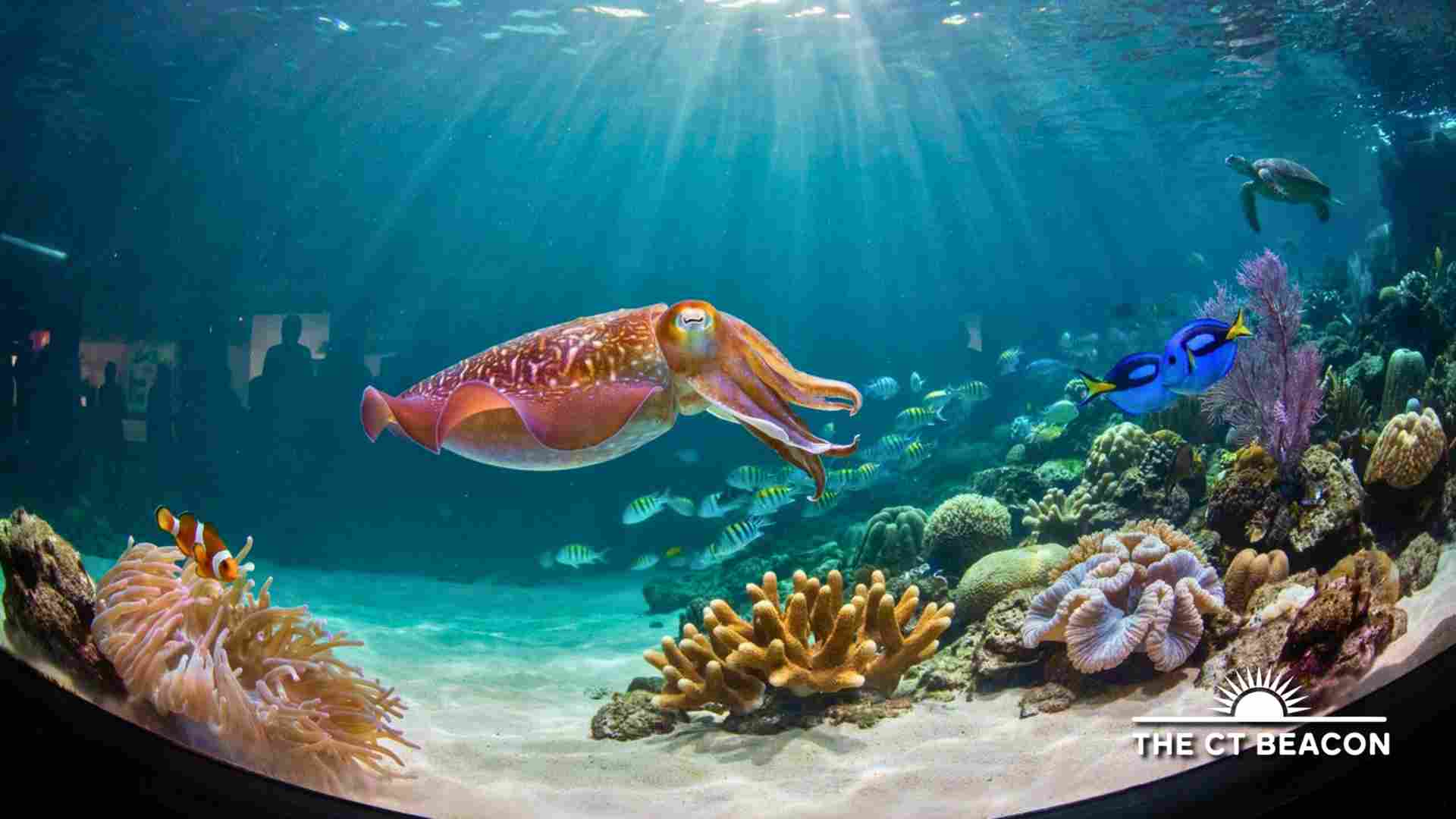
Featured image is an artistic representation inspired by the event and may not depict the actual people, location, or activities shown.