


Civil War Encampment Weekend Brings the 1860s to Life During Hopkinton’s 250th Celebration
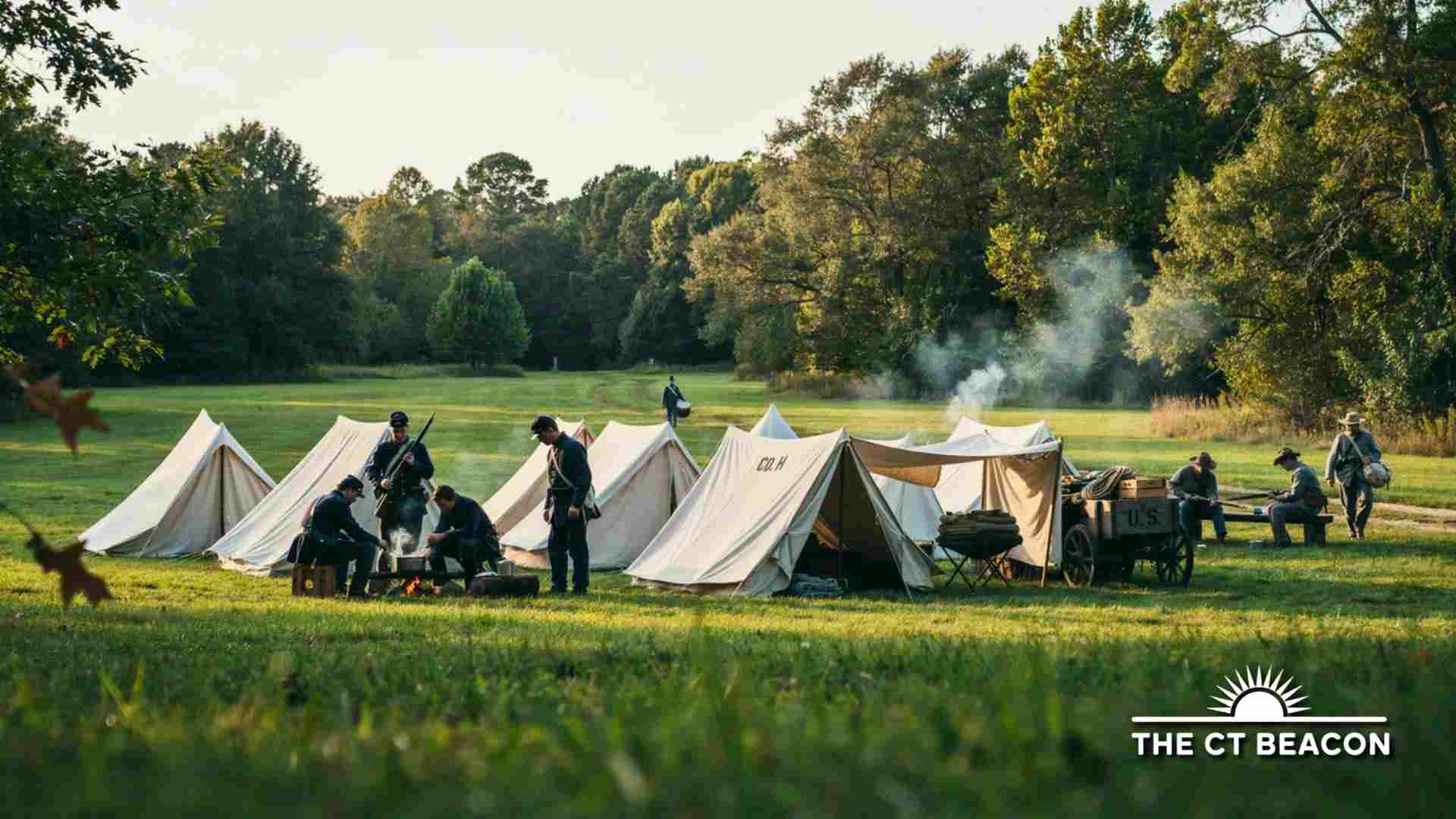
Civil War Encampment Weekend turns a corner of Crandall Field in Ashaway into an 1860s military camp on Saturday and Sunday, September 19–20, with living-history reenactors camping overnight, period clothing, music, historical storytelling, and the possibility of cannon fire.
And this one is bigger than the encampment alone.
The weekend is part of Hopkinton’s 250th anniversary celebration, so the town has built two days of activities around the living-history camp. There will be horse-drawn hayrides, food trucks, children’s activities, historical displays, and musicians roaming the grounds. Saturday adds an opening ceremony, community dinner, and fireworks. Sunday continues the encampment and concludes with an evening performance by The Swell Band.
With the exception of food and Saturday’s ticketed dinner, the activities are free.
The setting also gives the Civil War component some genuine local context. Men from Hopkinton served in Rhode Island regiments during the war, while Ashaway itself had connections to the abolition movement and Underground Railroad before the fighting began.
This Isn’t Just a Few Reenactors Stopping By for the Afternoon
The encampment is being established on the Route 216 side of Crandall Field, and the reenactors are staying there throughout the weekend.
That means tents, camp equipment and the routines of military life become part of the landscape rather than a brief scheduled demonstration.
Hopkinton’s organizers describe it as an opportunity to experience living history from the 1860s.
The encampment continues through both days and overnight Saturday, giving visitors a look at the physical world occupied by Civil War soldiers away from the battlefield.
For soldiers in the 1860s, battles occupied only a fraction of military service.
Much more time was spent in camp.
Soldiers drilled, cooked, cleaned equipment, wrote letters, repaired clothing, stood guard, waited for orders and tried to make themselves comfortable in circumstances that frequently were anything but comfortable.
Living-history encampments attempt to reconstruct some of that less dramatic but essential part of the Civil War experience.
And Yes, There May Be a Cannon
Organizers say the reenactors plan to fire their cannon if conditions and permissions allow.
That’s an important qualification.
The cannon firing isn’t guaranteed.
But if it happens, it should provide a rather convincing reminder that Civil War artillery is something very different when experienced physically instead of through a television speaker.
Even demonstration charges without projectiles produce tremendous concussion and sound.
The encampment continues rain or shine, according to Hopkinton’s official anniversary schedule.
The Weekend Begins With a Saturday Opening Ceremony
The formal celebration begins at 1 p.m. Saturday with an opening ceremony.
Local Boy Scouts will provide an honor guard, accompanied by patriotic music and presentations.
From there, the field becomes a mixture of eras.
The Civil War encampment occupies one portion of the grounds, while volunteers dressed in 19th-century clothing circulate through the celebration.
A wandering fiddler will perform music from the 1700s and 1800s, and a harpist will perform in the gazebo during meal periods.
Historical storytelling is planned for children and adults, with an emphasis on Rhode Island and Hopkinton history.
There will also be drawing and art activities for younger visitors built around a “Happy Birthday America!” theme.
Hopkinton’s Civil War Connection Was Personal
For Hopkinton families in the 1860s, the war wasn’t something happening exclusively in Virginia, Tennessee or Georgia.
Local men left town to fight.
Rhode Island responded quickly after the Confederate bombardment of Fort Sumter in April 1861. President Abraham Lincoln initially called upon the state to supply 780 men, and Rhode Island’s General Assembly moved rapidly to meet the request.
Within days, Rhode Island troops were leaving for war.
Among the first was the 1st Rhode Island Detached Militia under Col. Ambrose E. Burnside, who would become one of the state’s most famous Civil War figures.
The regiment included a company from nearby Westerly.
Over the next four years, Rhode Islanders served in infantry, cavalry, artillery and naval units across the war.
Hopkinton was part of that story.
A Dozen Hopkinton Men Went Into the 4th Rhode Island Together
One particularly interesting local connection involves the 4th Rhode Island Infantry.
Hopkinton did not raise enough men to form its own company for the regiment.
Instead, about a dozen Hopkinton men were placed in Company D, whose ranks otherwise came primarily from Glocester and Burrillville.
Historical accounts describe the Hopkinton recruits initially being regarded as the “South County Boys” by their northern Rhode Island comrades.
Eventually, those distinctions faded as the men trained and fought together.
The 4th Rhode Island would see serious combat, including the bloody fighting at Antietam and Fredericksburg.
That puts a local dimension on the rows of tents and military equipment visitors will see at Crandall Field.
For men from Hopkinton, an encampment like this once wasn’t a historical display.
It was where they lived.
Two Hopkinton Soldiers Died One Day Apart
The story becomes even more personal with the 7th Rhode Island Infantry.
Two young men connected to Hopkinton, George Washington Gardiner and Gideon Franklin Collins, served in Company A.
They died in October 1862 while the regiment was encamped in Maryland.
Not in battle.
From disease.
Gardiner died first. Collins followed the next day, on his 25th birthday, after contracting typhoid fever.
Their deaths were among the regiment’s first.
The loss made such an impression that Col. Zenas Randall Bliss ordered the entire regiment to participate in a funeral ceremony for them.
It’s a useful piece of history to remember while walking through a recreated military camp.
Disease killed enormous numbers of Civil War soldiers. Camp sanitation, contaminated water, infectious disease and primitive medical knowledge could be every bit as dangerous as combat.
Ashaway Had Another Connection to the Coming War
The story of Civil War-era Hopkinton actually begins before Fort Sumter.
Not far from the weekend’s celebration stands the historic Jacob D. Babcock House in Ashaway.
Babcock was an outspoken abolitionist.
He repeatedly ran for lieutenant governor on the Liberty and Free Soil tickets and became chairman of Rhode Island’s delegation to the first Republican National Convention in 1856.
Historical research also identifies his Ashaway home as a station on the Underground Railroad, although the secretive nature of that work means precise documentation of the people assisted there has not survived.
There’s an especially striking Civil War connection to the house.
On the night of December 31, 1862, Hopkinton residents gathered there as the clock approached midnight.
They were waiting for January 1, 1863.
The day Abraham Lincoln’s Emancipation Proclamation took effect.
That history happened only a short distance from where visitors will be walking among the encampment this weekend.
Rhode Island Sent Black Soldiers to War, Too
Rhode Island’s Civil War history also includes the 14th Rhode Island Heavy Artillery (Colored).
The regiment was composed of Black enlisted soldiers commanded, as was federal policy at the time, by white officers.
The unit served in Louisiana and Texas.
Although it did not experience major combat, disease took an enormous toll. The Rhode Island Historical Society notes that it suffered the highest number of deaths of any Rhode Island unit during the war, with nearly all resulting from disease.
The regiment was part of a much larger transformation after the Emancipation Proclamation opened the Union Army more broadly to Black enlistment.
By the end of the war, roughly 200,000 Black Americans had served in the Union Army and Navy.
That makes the local story of abolition in Ashaway and the military history being interpreted this weekend parts of the same larger history.
Hopkinton Is Using the Weekend to Tell More Than Military History
The anniversary committee isn’t limiting its historical interpretation to soldiers.
The Tomaquag Museum is expected to participate with an exhibit highlighting Indigenous culture and regional history. Organizers say the museum may also promote the effort to create a statue honoring Ellison “Tarzan” Brown, the Narragansett runner from Westerly who twice won the Boston Marathon.
That matters in an anniversary celebration covering 250 years.
Hopkinton’s history didn’t begin with European settlement, and it certainly can’t be understood solely through wars.
The weekend’s historical storytelling is intended to broaden the picture.
Horse-Drawn Hayrides and Period Music Fill Out the Grounds
Not everything requires a history lesson.
Horse-drawn hayrides will operate around the grounds.
A wandering fiddler will perform music dating from the 18th and 19th centuries.
A harpist will provide music during meal periods.
Volunteers in period clothing will circulate through the celebration.
Food trucks and local vendors will be on site throughout the weekend.
Three large tents are being erected to provide shelter and meal space, an important detail because the celebration is scheduled to proceed rain or shine.
The town is also providing an accessible transportation option. Hopkinton’s handicapped shuttle van will run between Ashaway School and the Crandall House.
Saturday Night Ends With Fireworks
Saturday has the more elaborate evening schedule.
A community pulled pork and chicken dinner begins at 5 p.m., with mac and cheese, pork and beans, cornbread and salad.
Unlike the rest of the celebration, the dinner isn’t free.
Tickets are $28 per person, must be purchased in advance and will not be sold on site Saturday.
People without dinner tickets aren’t being left hungry. Food trucks and other vendors will continue selling food.
Then, at 7:30 p.m., fireworks are scheduled over Crandall Field.
Severe weather could push the fireworks to Sunday, but the Civil War encampment itself continues regardless of the weather.
Sunday Keeps the Encampment Going
The Westerly Sun’s Sunday listing begins at 1 p.m., and Hopkinton’s official schedule likewise identifies 1 p.m. as Sunday’s start time for the anniversary activities.
The Civil War camp, however, is described by organizers as continuous throughout the weekend, with reenactors remaining on site overnight.
Sunday again includes food trucks, period music, volunteers in 1800s clothing, storytelling and children’s activities.
The weekend then makes a considerable chronological leap.
At 5:45 p.m. Sunday, The Swell Band is scheduled to perform.
That’s less Civil War camp and more community birthday party.
Which is really what this entire weekend is.
Why Hopkinton Is Celebrating 250 Years in 2026
Hopkinton’s anniversary activities commemorate the town’s incorporation in 1757, but the community has been using 2026 for a broad series of commemorative activities connected with local history and America’s 250th anniversary era.
The celebration isn’t confined to one weekend.
Earlier activities took place in June, while the Civil War Encampment Weekend occupies September 19–20.
A Liberty Tree Planting Ceremony follows on September 26.
The Crandall House itself is part of Hopkinton history.
The historic property dates to around the turn of the 19th century, and the Crandall House and surrounding field were acquired by the town in 1976, following a gift from the Crandall family combined with federal funding.
Today the property functions as a recreation and community center.
For one September weekend, the field becomes something else.
Canvas tents go up.
Period clothes come out.
A fiddler begins playing.
And, if everything goes according to plan, somewhere on the Route 216 side of the field a cannon is going to make sure everyone knows the Civil War encampment has arrived.
Details
Event: Civil War Encampment Weekend
Dates: Saturday–Sunday, September 19–20, 2026
Sunday Time: Anniversary activities begin at 1 p.m.; the Civil War encampment is continuous through the weekend
Location: Crandall House and Crandall Field
Address: 188 Main Street, Ashaway, RI 02804
Encampment Location: Route 216 side of Crandall Field
Admission: Free
Civil War Encampment: Living-history camp operating throughout the weekend and overnight
Cannon: Firing is planned if conditions and permissions allow
Other Activities: Historical storytelling, children’s activities, period-costumed volunteers, wandering fiddler, harp music, horse-drawn hayrides, historical displays, food trucks and vendors
Saturday Opening Ceremony: 1 p.m.
Saturday Community Dinner: 5 p.m.; $28 advance ticket required, no day-of dinner ticket sales
Saturday Fireworks: 7:30 p.m.; may move to Sunday in severe weather
Sunday Music: The Swell Band at 5:45 p.m.
Weather: Rain or shine; Civil War encampment continues regardless of weather
Accessibility: Hopkinton’s handicapped shuttle van will transport visitors between Ashaway School and the Crandall House
Parking: Follow event signage and directions at the Crandall House/Field area
More information is available at the Event Website link below.
Featured image is an artistic representation inspired by the event and may not depict the actual people, location, or activities shown.