


- This event has passed.
Beatles vs. Stones – A Musical Showdown at Foxwoods
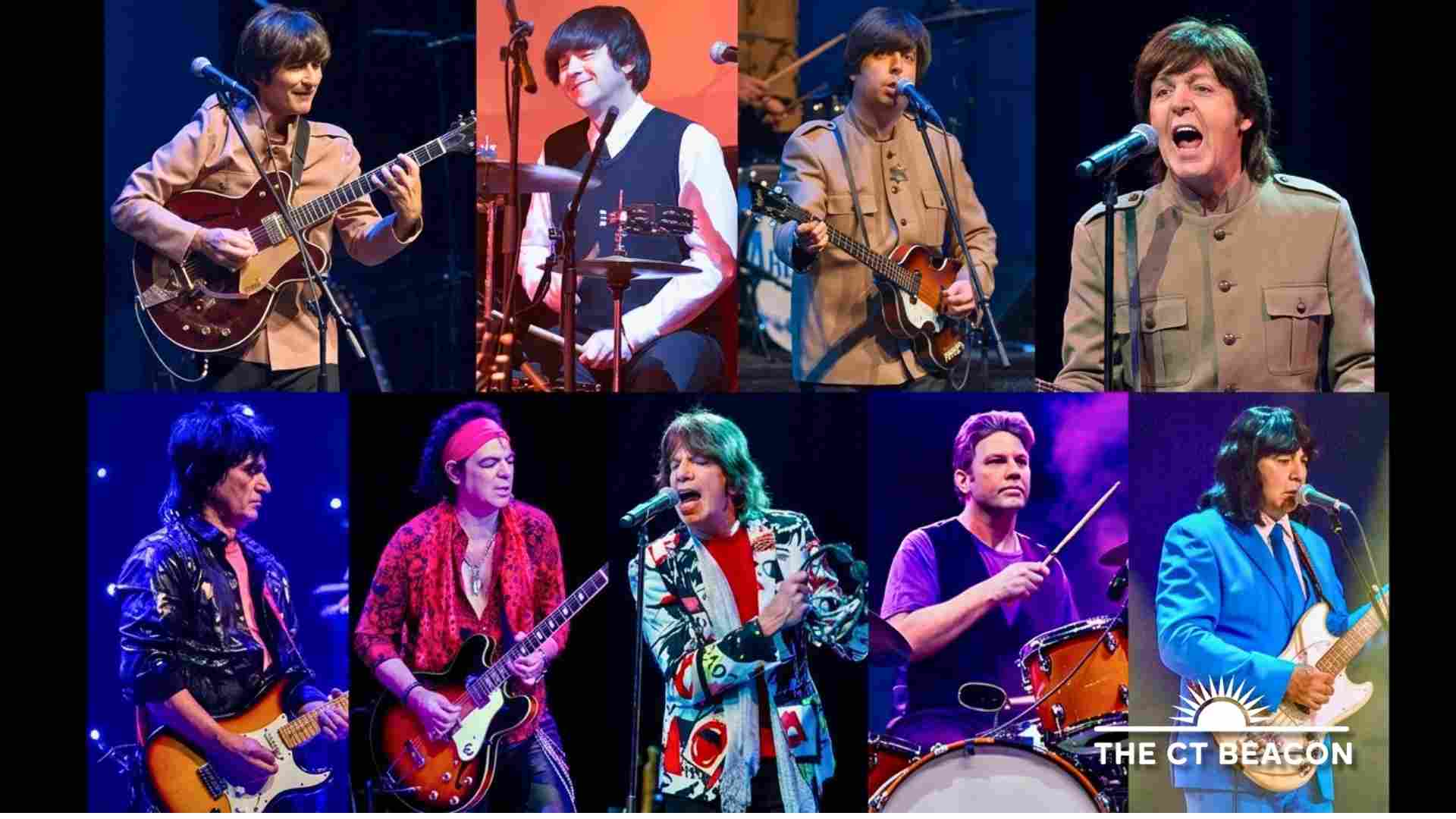
Beatles vs. Stones – A Musical Showdown at Foxwoods puts rock’s most enduring argument onstage Saturday, September 5, when two nationally touring tribute bands face off at the Great Cedar Showroom.
On one side is Abbey Road, recreating the music and changing looks of The Beatles. On the other is Satisfaction – The International Rolling Stones Show, taking on Mick Jagger, Keith Richards and the Stones.
This isn’t a conventional double bill. The bands alternate sets throughout the night, answering one Beatles run with a Stones run before eventually putting the rivalry aside and joining together for the finale.
The question hanging over all of it has survived for more than 60 years.
Beatles or Stones?
Liverpool vs. London
The rivalry was almost irresistible from the beginning.
The Beatles arrived as four young men from Liverpool in matching suits, with carefully arranged harmonies, enormous pop hooks and the kind of screaming audience reaction that quickly became known as Beatlemania.
The Rolling Stones offered something different.
They were bluesier. Rougher around the edges. Mick Jagger prowled across the stage. Keith Richards looked considerably less interested in behaving himself.
If The Beatles could be presented as the boys parents might reluctantly allow their daughters to meet, the Stones were marketed as the alternative.
That contrast helped create one of popular music’s great dividing lines.
Were you a Beatles person or a Stones person?
Beatles vs. Stones builds an entire show around making you choose again.
Abbey Road Takes the Beatles Side
Representing the Fab Four is Abbey Road, a Beatles tribute band that doesn’t limit itself to one period of the group’s career.
That matters because The Beatles changed dramatically in a remarkably short amount of time.
The band that appeared on The Ed Sullivan Show in February 1964, dressed in matching suits and singing “All My Loving” and “I Want to Hold Your Hand,” looked and sounded very different from the group that created Sgt. Pepper’s Lonely Hearts Club Band just three years later.
Abbey Road uses costumes, instruments and staging to follow that evolution.
The early Beatles give way to the increasingly experimental music and imagery of the later 1960s, allowing the show to move through different chapters of a career that lasted only about a decade but changed popular music.
Satisfaction Answers for the Stones
Then it’s the Rolling Stones’ turn.
Satisfaction – The International Rolling Stones Show has been touring its tribute to the band for years, with Chris LeGrand taking on the role of Mick Jagger.
That’s a formidable assignment.
Jagger isn’t simply a singer whose songs need to be performed accurately. His movement, mannerisms and stage presence became part of the identity of the Rolling Stones.
And the Stones catalog provides plenty of ammunition for a musical showdown.
“(I Can’t Get No) Satisfaction.”
“Jumpin’ Jack Flash.”
“Paint It Black.”
“Sympathy for the Devil.”
“Gimme Shelter.”
“Start Me Up.”
The songs span decades because the Rolling Stones did something their supposed rivals never had the opportunity to do.
They kept going.
The Beatles Had Seven Years. The Stones Had Decades.
This is where comparing the two bands becomes almost unfair.
The Beatles released their first UK single, “Love Me Do,” in 1962. By 1970, the band was over.
Their period as international superstars was even shorter.
Yet during that compressed stretch, John Lennon, Paul McCartney, George Harrison and Ringo Starr moved from Beatlemania through increasingly sophisticated studio albums including Rubber Soul, Revolver, Sgt. Pepper’s Lonely Hearts Club Band, The Beatles and Abbey Road.
The Rolling Stones took another route.
Formed in London in 1962, they built their early identity around American blues and R&B before Mick Jagger and Keith Richards developed into one of rock’s defining songwriting partnerships.
Then they survived.
Personnel changed. Musical fashions changed. Punk arrived. Disco arrived. MTV arrived. Grunge arrived.
The Stones remained.
That longevity became part of their argument in the great Beatles-versus-Stones debate.
The Beatles changed music extraordinarily quickly.
The Stones became one of rock’s ultimate survivors.
The Rivalry Wasn’t Quite What We Remember
There’s one problem with the great Beatles-Stones feud.
The actual musicians didn’t behave much like mortal enemies.
The bands certainly competed, and comparisons between them were unavoidable, but their relationship was considerably friendlier than the mythology suggests.
John Lennon and Paul McCartney even gave the Stones a song.
“I Wanna Be Your Man,” written by Lennon and McCartney, became an early Rolling Stones single in 1963. The Beatles subsequently released their own version with Ringo Starr singing lead.
Members of the two groups socialized and followed each other’s work as both bands helped transform British popular music.
The public rivalry was simply too good to resist.
The clean-cut Beatles versus the dangerous Stones.
Pop versus blues.
Liverpool versus London.
Lennon and McCartney versus Jagger and Richards.
More than six decades later, that argument is still selling tickets.
They Never Gave Us the Concert This Show Imagines
Here’s what makes the premise particularly fun.
The Beatles and Rolling Stones never gave audiences the great head-to-head concert that rock history seems to demand.
The Beatles stopped touring in 1966, years before the stadium-rock era fully developed.
Beatles vs. Stones – A Musical Showdown was created decades later to imagine what might have happened if the two catalogs had actually shared a stage.
The touring production launched in 2011 and has since played across the United States and internationally, including extended casino showroom residencies.
Instead of placing one tribute band before the other, the production turns the competition into the structure of the show.
Abbey Road plays.
Satisfaction responds.
Then it’s back to The Beatles.
Then back to the Stones.
The two sides trade sets, songs and a little trash talk along the way.
So Who Wins?
That’s up to the audience.
Maybe it’s The Beatles, with the extraordinary progression from “I Want to Hold Your Hand” to “A Day in the Life” in the space of just a few years.
Maybe it’s the Stones, with the opening riff of “(I Can’t Get No) Satisfaction,” the menace of “Gimme Shelter” and a catalog built across decades.
Or maybe the premise eventually collapses for the same reason the original rivalry did.
You don’t actually have to choose.
Foxwoods says Abbey Road and Satisfaction will come together onstage for the show’s encore, turning the musical shootout into something the real Beatles and Rolling Stones never gave audiences.
Both bands.
One stage.
And after more than 60 years of arguing about it, probably no definitive winner.
Event Details
Event: Beatles vs. Stones – A Musical Showdown
Date: Saturday, September 5, 2026
Time: 8 p.m.
Location: Great Cedar Showroom at Foxwoods Resort Casino
Address: 350 Trolley Line Boulevard, Mashantucket, CT 06338
Beatles Tribute: Abbey Road
Rolling Stones Tribute: Satisfaction – The International Rolling Stones Show
Format: Alternating sets followed by a joint encore
Genre: Classic Rock
Best Parking: Grand Pequot Tower
Bag Policy: No shopping bags or backpacks permitted; all bags are subject to search
More information is available at the Event Website link below.
To purchase tickets, click the Event Ticketing link below.
Featured image is an artistic representation inspired by the event and may not depict the actual people, location, or activities shown.