


- This event has passed.
Fall Foraging with Amelia South at DPNC
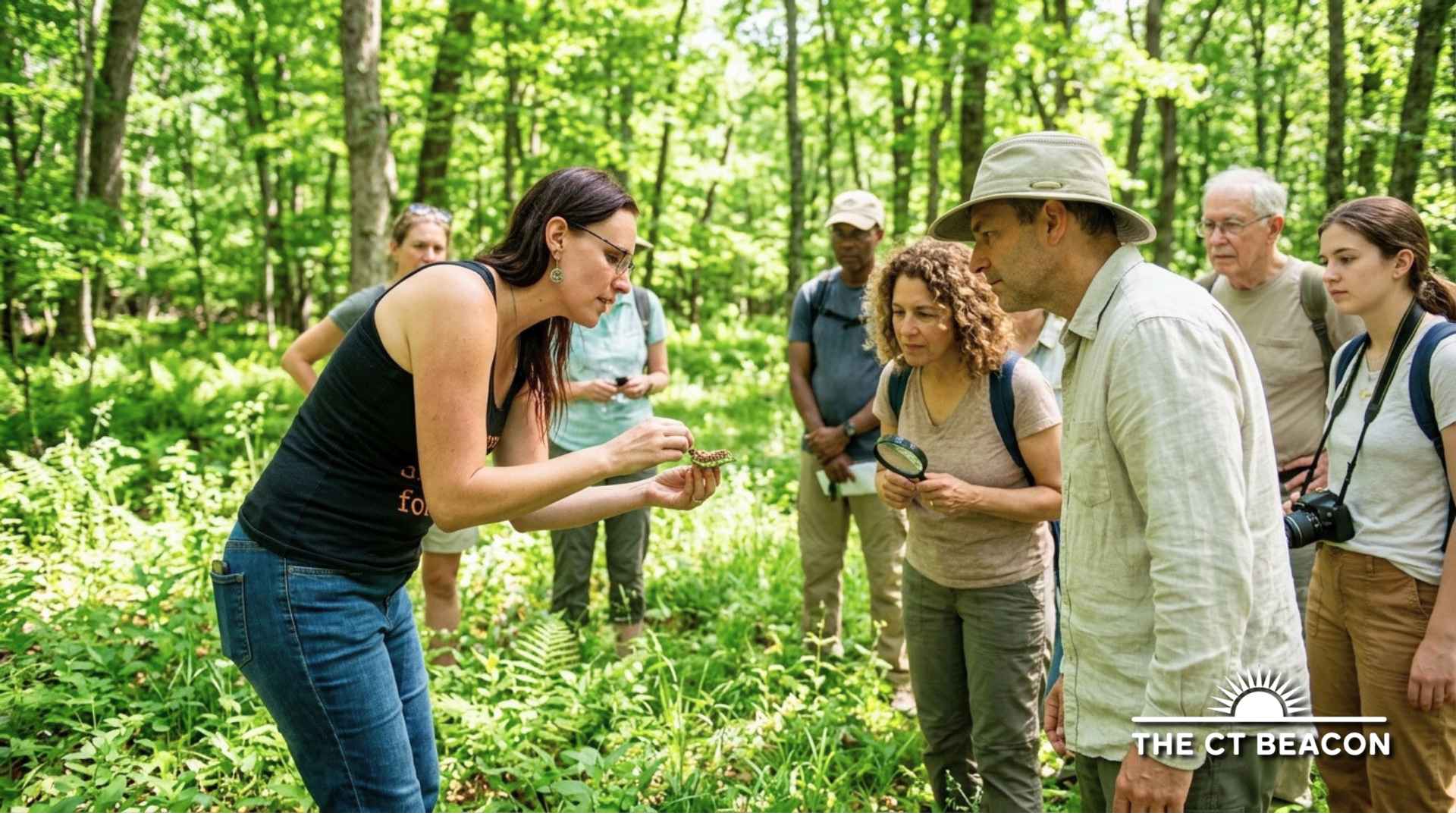
Fall Foraging with Amelia South at DPNC takes participants off the grocery-store produce aisle and onto the trails of Mystic on Saturday, September 12, for a hands-on introduction to identifying and sustainably harvesting wild foods and useful plants.
The adult program runs from 10 a.m. to 12:30 p.m. and is led by Amelia South, a Connecticut clinical herbalist, longtime forager, and founder of Black Sun Farm in Killingly.
Rather than presenting foraging as simply finding something in the woods that happens to be edible, South teaches identification, responsible harvesting, and the larger skill of learning to recognize the plants growing around us.
It’s a skill she’s been developing for about two decades.
Amelia South Started Foraging in 2006
South describes herself as a clinical herbalist, foraging instructor, author, and founder of Black Sun Farm and the No-BS Herbalist.
Her relationship with wild food began in 2006, when she started intentionally foraging. Her interest expanded into herbalism and natural health several years later, and she began growing food, preparing herbal products and studying how plants traditionally have been used as both food and medicine.
Today, she teaches classes and guided foraging walks around Connecticut.
South received her Clinical Herbalist certification through Heart of Herbs Herbal School in July 2026 and has also studied health sciences. She says she has spent nearly 20 years learning about plants, food and the human body.
That experience is important for a subject where confidence can become dangerous very quickly.
Knowing that a plant is “probably” something isn’t good enough if you’re planning to eat it.
Foraging Begins With Identification
One of the first lessons of responsible foraging is also the least exciting:
If you aren’t certain what something is, don’t eat it.
Plants and mushrooms can have look-alikes, and visual similarities that appear insignificant to a beginner can separate an edible species from one that can cause illness.
South’s other foraging programs have specifically addressed how to distinguish edible and medicinal species from potential look-alikes, moving from instruction into the field so participants can practice identification with actual plants.
Saturday’s DPNC program puts that lesson directly on the landscape.
Instead of looking at photographs or specimens on a table, participants will walk the Nature Center trails and learn to recognize herbs and other edible plants where they actually grow.
That means paying attention to more than a flower.
Leaves, stems, bark, growth patterns, habitat, scent, texture and season can all provide clues.
Over time, the goal is to stop seeing an anonymous wall of green.
Fall Changes What’s Available
A September foraging walk is a very different experience from one held in April or June.
Plants change through the seasons.
Spring often emphasizes young greens, shoots and flowers. By late summer and early fall, the landscape begins shifting toward fruits, berries, nuts, seeds and roots, while some familiar plants become easier to identify because they’ve reached a mature stage.
Exactly what participants find Saturday will depend on what is growing along the trails that morning.
That’s part of foraging.
There is no supermarket inventory sheet guaranteeing that a particular wild food will be waiting on a particular shelf.
Weather, habitat, recent rainfall, wildlife and the timing of an individual plant all affect what appears.
A good foraging walk therefore teaches something more transferable than where to find one specific plant.
It teaches how to look.
Sustainable Harvesting Means Knowing What to Leave Behind
Finding an edible plant doesn’t automatically mean it should be picked.
DPNC specifically describes Saturday’s program as teaching participants how to sustainably harvest wild herbs and other edibles.
That’s an important part of modern foraging.
A responsible harvester considers how abundant a plant is, which portion is being removed, whether harvesting will kill it, how much should be left for reproduction and what role the plant plays in the surrounding ecosystem.
Roots present an obvious example. Harvesting a few leaves may allow a perennial plant to continue growing. Digging up its root can remove the entire plant.
Seeds, berries and nuts are also food for wildlife and part of the plant’s reproductive cycle.
Rare or threatened species shouldn’t become dinner simply because someone has learned to identify them.
South has spoken publicly about approaching wildcrafting with the needs of the plant in mind rather than simply harvesting whenever something can be sold or used.
The lesson is straightforward: knowing what you can harvest is only half the skill.
You also need to know whether you should.
South Has Taught People to Find Food in Their Own Backyards
One of the appealing things about foraging is that it doesn’t necessarily require traveling deep into wilderness.
At a June 2026 Wild Ones program in Fairfield County, South spent nearly two hours walking a four-acre property and identifying edible and traditionally medicinal plants growing there.
Participants eventually used some of what they encountered in hands-on demonstrations, including preparing eggs with sorrel and chickweed and making syrup using shagbark hickory bark.
The experience illustrated something beginners frequently discover.
Once someone teaches you what to recognize, plants that previously registered as “weeds” or background vegetation begin acquiring names.
The landscape hasn’t changed.
Your ability to read it has.
A Nature Center Is a Natural Classroom
Denison Pequotsepos Nature Center provides an unusually good setting for that kind of lesson.
DPNC’s protected lands contain forests, wetlands, meadows, ponds and streams, giving visitors access to multiple southeastern Connecticut habitats within the same trail system.
More than 10 miles of trails connect the Nature Center and surrounding protected lands, including Coogan Farm.
Individual routes around the Nature Center pass through markedly different environments. The Meadow Loop includes boardwalks and wetland habitat, while other trails enter forest, follow Pequotsepos Brook or pass old granite quarry areas and glacial terrain.
That habitat diversity matters to a forager because plants aren’t randomly distributed.
Some prefer wet ground.
Others thrive along disturbed edges.
Some need open sunlight.
Others belong beneath a forest canopy.
Learning where a plant is likely to grow can eventually become as useful as memorizing what its leaves look like.
DPNC Has Been Teaching People to Read This Landscape for Decades
The foraging walk also fits the broader purpose of Denison Pequotsepos Nature Center.
The Mystic nonprofit operates a nature sanctuary, natural history museum, wildlife rehabilitation program and environmental education center.
Its grounds support native wildlife and a substantial bird population, while the Nature Center cares for non-releasable birds of prey and other animal ambassadors used in education programs.
DPNC’s programming ranges from birding and wildlife programs to pond exploration, gardening, mushroom events, forest bathing and guided hikes.
Foraging adds another way of understanding the same environment.
A botanist might look at a plant and think about taxonomy.
A wildlife biologist might consider what eats it.
A gardener might think about whether it belongs in a landscape.
A forager asks another question:
What relationship have people had with this plant?
Foraging Is Part Natural History, Part Human History
Long before supermarkets, refrigeration and year-round produce shipments, knowing the local landscape wasn’t a hobby.
It was knowledge connected directly to food and survival.
People learned when particular plants emerged, which parts were edible, when nuts ripened, where berries grew and which plants could be preserved for later use.
Indigenous communities developed sophisticated plant knowledge over generations. European settlers arrived with their own traditions and encountered an unfamiliar North American landscape. Later immigrant communities brought additional food and herbal traditions.
Modern foraging draws from many of those histories, although responsible instruction also requires recognizing that traditional use isn’t the same thing as scientific proof of a medical benefit.
That’s especially important when the conversation moves from food into herbal medicine.
A plant can have a long history of traditional use without being a substitute for medical diagnosis or treatment.
For Saturday’s hike, the practical starting point is much simpler.
Learn what’s growing here.
Learn how to identify it.
Learn what people have done with it.
And learn how to leave enough behind.
Don’t Expect a Walk Through a Manicured Garden
This is a trail-based outdoor program.
DPNC’s trails move through natural terrain that can include roots, rocks, damp areas and uneven surfaces. September can also mean mosquitoes and ticks remain active.
Closed-toe walking or hiking shoes make sense, along with clothing appropriate for the weather. Long pants can provide some protection from ticks and vegetation, and participants may want water and insect repellent.
Because the purpose is identifying plants in their natural habitats, expect periods of stopping, looking closely and moving off the pace of an ordinary recreational hike.
This isn’t about covering miles.
A productive foraging walk can spend 15 minutes moving a very short distance because once you begin looking closely, there can be an extraordinary amount happening in a few yards of trail.
The Goal Isn’t to Become a Forager in 2½ Hours
Nobody should leave a single class believing they can safely identify every edible plant in Connecticut.
That’s not what makes an introductory foraging walk valuable.
The useful first step is learning how identification works.
Look closely.
Notice habitat.
Learn the characteristics that distinguish one species from another.
Understand that common names aren’t enough.
Know when a look-alike exists.
Don’t consume something because an app identified it from a photograph.
And understand that harvesting carries responsibilities beyond whether a plant is technically edible.
South has been intentionally foraging since 2006.
Saturday morning offers 2½ hours with someone who has spent two decades noticing things most of us walk past.
Afterward, the same Mystic trail may look considerably less anonymous.
Details
Event: Fall Foraging with Amelia South at Denison Pequotsepos Nature Center
Date: Saturday, September 12, 2026
Time: 10 a.m.–12:30 p.m.
Instructor: Amelia South
Program: Guided fall foraging and plant-identification hike
Ages: Adults
Venue: Denison Pequotsepos Nature Center
Address: 109 Pequotsepos Road, Mystic, CT 06355
DPNC Members: $29.75
Nonmembers: $35
Registration: Advance registration is required
Setting: Outdoors on the Nature Center trails
What to Expect: Identification of wild herbs and other edible plants with instruction in sustainable harvesting
Recommended: Weather-appropriate clothing, sturdy walking shoes, water and insect/tick protection
Phone: 860-536-1216
More information is available at the Event Website link below.
To register, click the Event Registration link below.
Featured image is an artistic representation inspired by the event and may not depict the actual people, location, or activities shown.