


- This event has passed.
Belugas Count at Mystic Aquarium
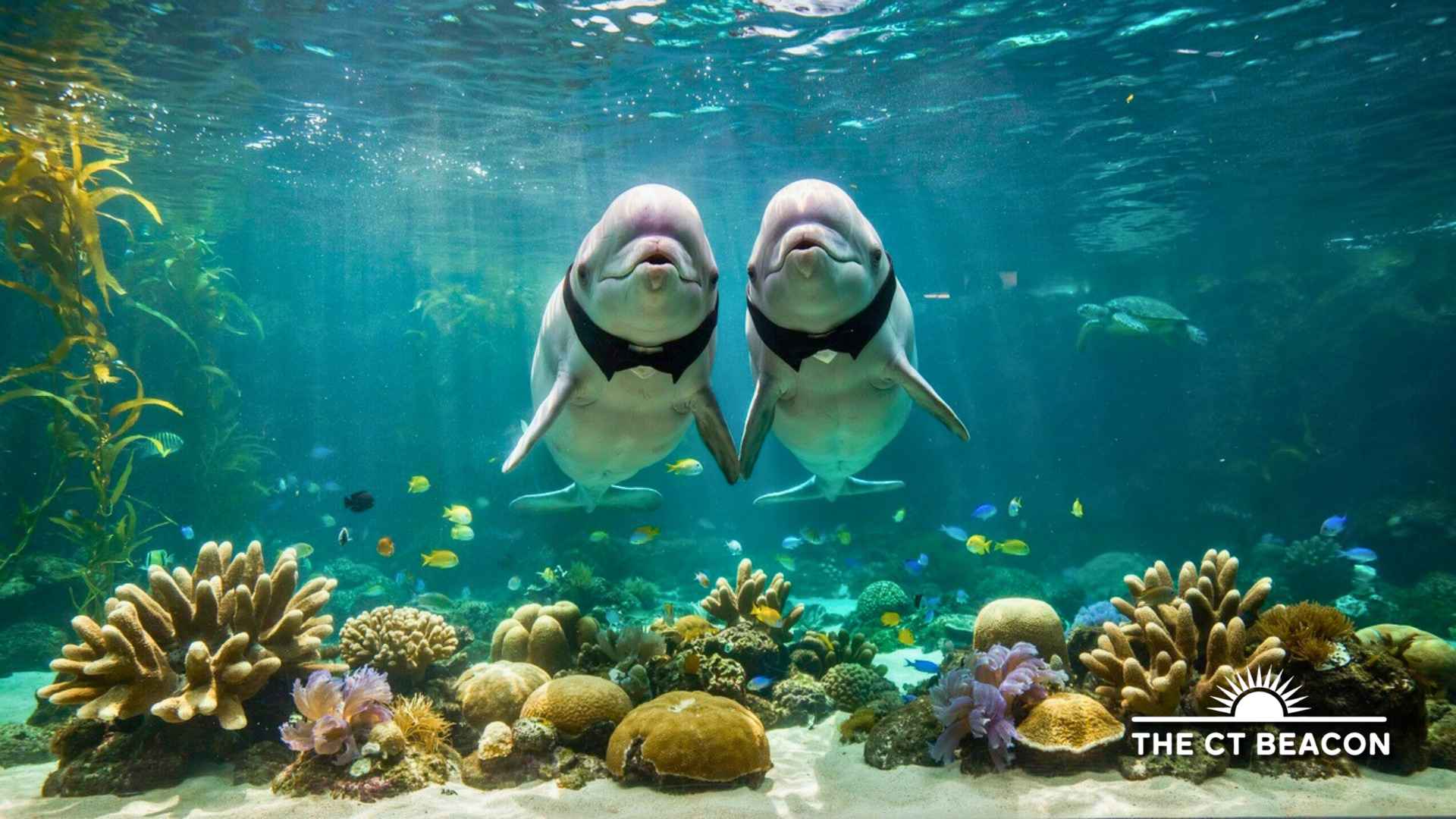
Belugas Count at Mystic Aquarium connects Connecticut families with a conservation effort taking place more than 3,000 miles away on Sunday, September 13, as Mystic celebrates its signature whales while scientists, volunteers, and residents in Alaska search the waters of Cook Inlet for one of America’s most endangered marine mammal populations.
The family-friendly event runs from 10 a.m. to 3 p.m. and is included with regular aquarium admission. Interactive tables and hands-on activities will explore belugas, their Arctic and sub-Arctic environment, Mystic Aquarium’s research in Alaska, and something that may initially seem far removed from whales: how building more resilient communities here at home can help protect ecosystems around the world.
September 13 wasn’t chosen randomly. The Mystic event coincides with the 2026 Belugas Count! Celebration in Alaska, where publicly accessible viewing stations around Cook Inlet will be staffed by beluga experts searching for, counting, and teaching visitors about the endangered whales.
Mystic Aquarium is one of the national partners supporting that effort.
The White Whales That Talk
Spend enough time beside Mystic Aquarium’s beluga habitat and one thing becomes apparent: these are unusually expressive whales.
Belugas whistle, chirp, squeal, click, and produce such a broad range of sounds that sailors nicknamed them the “canaries of the sea.”
Those sounds aren’t incidental.
Belugas live in Arctic and sub-Arctic waters where visibility can be poor, particularly around river mouths and estuaries filled with sediment. Sound is an essential part of how they navigate, locate prey and communicate.
The large rounded structure on a beluga’s forehead is called the melon. Unlike the fixed forehead people might imagine on a whale, a beluga’s melon is remarkably flexible. The animal can change its shape while producing and directing sounds used for echolocation.
A beluga sends out clicks and listens for the returning echoes, effectively building an acoustic picture of its surroundings.
It’s a useful ability for an animal that may spend part of the year living around sea ice or swimming through water where seeing what’s ahead isn’t particularly easy.
The scientific name Delphinapterus leucas reflects another unusual feature. Delphinapterus essentially means “dolphin without a fin.”
Belugas have no dorsal fin.
Instead, they have a tough dorsal ridge along their backs, an adaptation that makes sense for whales living in icy northern waters. A protruding fin would lose heat and could become a liability while moving beneath ice.
Belugas Aren’t Born White
The bright white color that makes an adult beluga almost unmistakable doesn’t appear at birth.
Calves are born dark gray and gradually become lighter as they grow, eventually turning white as adults.
They’re substantial animals. NOAA Fisheries says belugas can reach about 16 feet in length and average roughly 3,150 pounds, with lifespans potentially reaching 90 years.
They’re also toothed whales, generally possessing between 32 and 40 teeth.
Belugas are highly social and can gather in groups to feed, migrate and interact. Their flexible necks make them particularly distinctive among whales because their cervical vertebrae aren’t fused together. That allows a beluga to turn and move its head in ways most whales cannot.
And while they’re strongly associated with Arctic ice, their lives also depend on rivers.
During warmer months, belugas may congregate in shallow coastal areas and around river mouths where fish are abundant. Those relatively warm, shallow waters are particularly important for mothers and newborn calves, which haven’t yet developed the thick layer of blubber they’ll eventually use to insulate themselves from extreme cold.
In Alaska, September 13 Really Is About Counting Belugas
While visitors in Mystic are learning about belugas, people around Cook Inlet will be looking for the real thing.
NOAA Fisheries’ annual Belugas Count! event brings scientists, conservation organizations, Alaska Native communities, government agencies, universities, aquariums and members of the public together every September.
On Sunday, September 13, publicly accessible observation stations will be operating at locations around Cook Inlet.
People armed with binoculars will watch the water alongside beluga experts.
When whales appear, they’ll look.
They’ll count.
And they’ll learn why every whale matters.
An afternoon celebration at the Alaska Zoo will add educational booths, children’s activities and presentations by beluga specialists.
Elsewhere along Cook Inlet, the Alaska Wildlife Conservation Center will conduct monitoring from 10 a.m. to 1 p.m., with volunteers recording beluga sightings and environmental observations that can contribute to ongoing conservation work.
Mystic Aquarium’s Connecticut celebration effectively becomes an East Coast extension of something happening in Alaska that same day.
Why Scientists Are So Concerned About Cook Inlet
There isn’t just one worldwide population of belugas.
Several distinct populations inhabit northern waters, and the whales living in Alaska’s Cook Inlet are particularly important because they remain there throughout their lives and are genetically distinct from other beluga populations.
Their story is alarming.
NOAA estimates that between 1979 and 2018, the Cook Inlet population fell nearly 80 percent, from approximately 1,300 whales to 279.
The population was listed as endangered under the federal Endangered Species Act in 2008.
The newest estimate offers a small measure of hope: approximately 331 Cook Inlet belugas.
Scientists say that could indicate the population is stabilizing and possibly beginning to increase. But there isn’t enough evidence yet to declare a recovery. Continued monitoring over the coming years will be needed to determine whether the change represents a genuine upward trend.
That’s what gives the event’s name some weight.
When only a few hundred animals remain in a distinct population, individual whales really do count.
Stopping the Hunt Didn’t Solve the Problem
The Cook Inlet decline has a complicated history.
Subsistence hunting contributed substantially to the population’s earlier losses, and harvest restrictions followed. Alaska Native hunters last harvested Cook Inlet belugas in the mid-2000s, and harvest has not been permitted for years because the population remains below management thresholds.
Scientists expected removing that pressure would help the population rebound.
It didn’t rebound as expected.
That shifted the research question from what caused the original decline? to something more difficult:
What’s preventing the whales from recovering now?
NOAA’s recovery work identifies a collection of potential pressures rather than one simple explanation.
They include underwater noise, reduced or changing prey availability, habitat degradation, pollution and contaminants, disease, strandings, climate-related changes, predation by killer whales and the cumulative effects of several stressors occurring together.
Cook Inlet makes those questions especially challenging because it isn’t an isolated Arctic wilderness.
Anchorage and the Belugas Share the Same Neighborhood
Cook Inlet stretches north from the Gulf of Alaska, and its upper reaches border Anchorage, the state’s largest city.
That puts an endangered whale population beside Alaska’s largest concentration of people, transportation and industrial activity.
During ice-free months, Cook Inlet belugas concentrate heavily in upper Cook Inlet and around river mouths where salmon and other fish provide food.
Those same waters are influenced by shipping, construction, development and other human activity.
Noise is particularly important for an animal that relies so heavily on sound.
If a beluga uses acoustics to communicate, find food and understand its environment, underwater noise isn’t merely an annoyance. It can interfere with some of the sensory information the whale depends upon.
NOAA reviews projects in Cook Inlet for their potential effects on belugas and has developed guidelines intended to reduce harmful underwater construction noise.
Two large portions of Cook Inlet were designated critical habitat in 2011 because they contain feeding areas and places that provide refuge from predators. (NOAA Fisheries)
Mystic Aquarium’s Connection Goes All the Way to Alaska
That brings the story back to Connecticut.
Mystic Aquarium isn’t participating in Belugas Count simply because belugas happen to be the aquarium’s best-known animals.
The institution has been involved in beluga research and conservation, including work connected to Cook Inlet.
NOAA lists Mystic Aquarium among the partner organizations supporting Belugas Count!, alongside the Alaska Zoo, Alaska Wildlife Conservation Center, Cook Inlet Beluga Whale Photo-ID Project, Alaska Beluga Monitoring Program, Georgia Aquarium, Shedd Aquarium, Alaska Native organizations, government agencies and conservation groups.
That collaboration is important because researchers can’t answer every question about a small, endangered population by working directly with wild animals.
Some questions require field observations in Alaska. Others can be investigated through acoustic monitoring, population surveys, photographic identification, health assessment and biological research.
Aquariums can contribute another piece by allowing scientists to conduct carefully controlled research with animals in human care.
Mystic’s long association with belugas therefore creates a bridge between the whales visitors can watch in Connecticut and animals scientists are trying to save in Alaska.
The “Canaries of the Sea” Have a Noise Problem
There’s an irony at the heart of beluga conservation.
One of the things that makes the species extraordinary may also make it particularly vulnerable to a changing environment.
Belugas are acoustic animals.
They live in a world of sound.
Their clicks can help them find objects and prey. Their whistles and other vocalizations help them communicate. Their hearing gives them information that human beings would primarily gather with their eyes.
Now imagine continually adding sound to that environment.
Ships. Construction. Industrial activity. Machinery.
NOAA identifies ocean noise as an important threat to Cook Inlet belugas and studies how human-generated sound can affect marine mammal behavior and hearing. Research suggests sufficiently intense disturbance can interrupt normal behavior and potentially drive whales away from habitat important to their survival.
That makes the familiar squeaks, whistles and clicks of a beluga more than an entertaining fact for an aquarium sign.
Understanding how belugas communicate may help scientists understand how to protect them.
From Cook Inlet to Long Island Sound
Mystic Aquarium describes Sunday’s event as connecting the Arctic with “our own backyard.”
That’s where Belugas Count becomes broader than a day about whales.
Connecticut doesn’t have a population of belugas swimming through Long Island Sound. But some of the environmental questions aren’t particularly foreign.
Healthy waterways depend on healthy watersheds. Animals depend on reliable food webs. Pollution that enters rivers doesn’t necessarily remain where it started. Coastal ecosystems respond to development and climate pressures. Communities have to decide how to balance human activity with habitat protection.
That’s why Sunday’s activities are also built around the idea of resilience.
The endangered whales of Cook Inlet provide a dramatic example of what happens when a population falls far enough that recovery becomes difficult.
The local lesson is considerably more optimistic.
Conservation doesn’t have to begin after an ecosystem reaches a crisis.
It can begin with understanding how the pieces fit together.
See the Whales, Then Understand Why They Matter
There’s a natural advantage to holding Belugas Count at Mystic Aquarium.
The subject of the conservation story is swimming nearby.
A child can learn that a beluga uses its melon for echolocation and then walk over and look at one.
They can discover that calves begin life gray and see what an adult white whale looks like.
They can learn that belugas communicate acoustically and then understand why underwater noise in Cook Inlet could matter.
And they can discover that while the whales in Mystic are ambassadors for their species, hundreds of their wild counterparts in Alaska are part of an endangered population whose future remains uncertain.
That’s the connection Belugas Count is trying to make.
The distance between Mystic and Alaska is enormous.
The conservation story isn’t.
Details
Event: Belugas Count at Mystic Aquarium
Date: Sunday, September 13, 2026
Time: 10 a.m.–3 p.m.
Event Type: Family / Animals / Conservation / Educational
Activities: Interactive tables, hands-on activities and educational programming about belugas, Arctic ecosystems, conservation and community resilience
Admission: Included with regular Mystic Aquarium general admission
Venue: Mystic Aquarium
Address: 55 Coogan Boulevard, Mystic, CT 06355
Parking: Free on-site parking
Phone: 860-572-5955
General Information: info@mysticaquarium.org
More information is available at the Event Website link below.
Excerpt:
Meta Description:
Featured image is an artistic representation inspired by the event and may not depict the actual people, location, or activities shown.