


- This event has passed.
History Day at Samuel Smith Farmstead
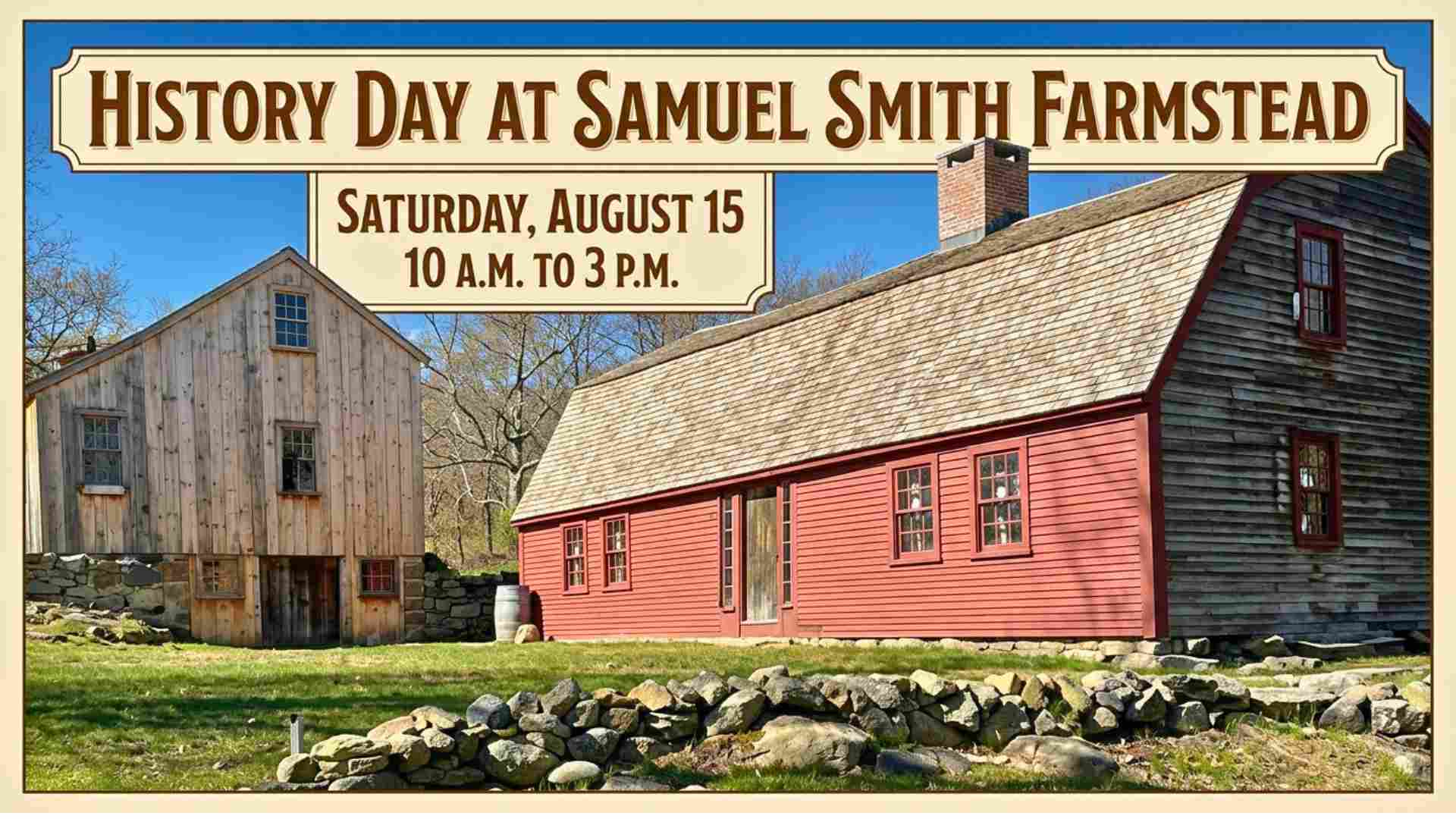
History Day at Samuel Smith Farmstead turns the East Lyme property into a living-history classroom on Saturday, August 15, from 10 a.m. to 3 p.m. The free event explores everyday life in 18th-century Connecticut through Revolutionary-era clothing, spinning demonstrations, hearth cooking and tours of the historic John Johnson House.
Rather than putting artifacts behind glass, History Day focuses on how things were actually done. Visitors can watch fibers become yarn on an antique spinning wheel, see corn chowder prepared over a colonial fireplace and learn what clothing could reveal about the people who lived and worked in Connecticut during the American Revolution.
The setting adds considerably to the experience. The centerpiece of the Samuel Smith Farmstead is the John Johnson House, a remarkably intact colonial home dating to about 1748. The house and surrounding property are being preserved as a living museum of Connecticut farm life, making History Day less a recreation dropped into a modern location than a chance to interpret the past in a place where that history actually happened. (Samuel Smith Farmstead)
Living History with the Dirty Blue Shirts
The Dirty Blue Shirts will present two programs during History Day: “Clothing & Fabric in the 18th Century” and “The Farmstead During the American Revolution.”
The Connecticut-based living-history group specializes in researched interpretations of everyday life rather than simply dressing in period clothing. Its programs explore material culture, women’s history, maritime history and the Revolutionary era, often incorporating hands-on demonstrations to show how people worked and lived. (Dirty Blue Shirts)
Their 2026 schedule includes programs across Connecticut and Rhode Island tied to America’s 250th anniversary, and the group specifically lists its August 15 appearance at Samuel Smith Farmstead as a living-history event.
For visitors, that means clothing becomes more than costume. Fabrics had to be produced, purchased, altered, repaired and reused, and what someone wore could reflect occupation, wealth and circumstance. Those details provide another way into the Revolutionary period beyond battles and famous political figures.
Spinning Wool, Mohair, Silk and Alpaca
Jessica Hoadley will demonstrate the art of turning natural fibers into yarn using an antique spinning wheel.
The demonstration includes wool, mohair, silk and alpaca, allowing visitors to see differences between materials that can look fairly similar once they’ve become finished clothing.
It’s also a reminder of how many steps stood between raw material and a piece of clothing in the 18th century. Before fabric could become a shirt, dress or blanket, fibers had to be prepared and spun into usable thread or yarn.
Watching that happen by hand gives a much clearer sense of the time and skill hidden inside an ordinary piece of colonial clothing.
Colonial Cooking at the Fireplace
History Day moves into the kitchen with Colonial Cooking with Courtney, who will prepare corn chowder in the fireplace.
There won’t be a temperature dial or stovetop burner involved. Hearth cooking required managing an actual fire, positioning pots correctly and judging heat through experience.
Food also offers an unusually direct way to understand daily life. A farm family’s meals depended on what could be grown, preserved, stored or obtained locally, and the fireplace wasn’t decorative. It was one of the working centers of the household.
Tour the John Johnson House
Visitors can also tour the historic John Johnson House, built around 1748.
Research into the building has included architectural investigation, archaeology and even dendrochronology, which uses tree rings in structural timbers to help establish construction dates. Archaeological work on the property recovered 1,887 artifacts, primarily dating to the 18th and 19th centuries. (
The house is listed on the National Register of Historic Places, while the property has been identified by Connecticut’s Office of State Archaeology as an archaeological site containing both prehistoric and colonial deposits.
Much of the house’s historic fabric survives, making the tour particularly useful alongside the day’s living-history demonstrations. Instead of imagining where a colonial family cooked and worked, visitors can walk through the rooms themselves.
A Farmstead with Revolutionary War Connections
History Day’s focus on the American Revolution has a direct connection to the people who lived here.
John Johnson Jr. and his son Reynolds Johnson served in the local militia and Coastal Guard during the Revolution. John responded to the Lexington alarm and helped construct Fort Trumbull in New London before serving as an officer closer to home. His teenage son later joined the Coastal Guard under his father’s command.
Their job included patrolling the shores of Niantic Bay, where Loyalists could cross Long Island Sound from British-controlled Long Island in small boats to obtain supplies.
That history recently brought national attention to the house.
A Little Piece of Ken Burns’ The American Revolution
Visitors who watched Ken Burns’ 2025 PBS series The American Revolution may have already seen part of the Samuel Smith Farmstead without realizing it.
The production initially contacted the Farmstead about photographing the historic house’s front door. Once the crew was there, Farmstead board president Betsey Goetsch invited them inside.
They filmed the interior, including the kitchen, and footage from the John Johnson House ultimately appeared in the documentary’s first episode, In Order to Be Free. (CT Insider)
That makes the house an especially interesting place to visit during America’s 250th anniversary year. The same rooms being used to teach visitors about Revolutionary-era Connecticut were selected to help represent that period for a national television audience.
About Samuel Smith Farmstead
The Farmstead sits on 17 acres of rural land that were once part of a 37.5-acre parcel purchased by Samuel Smith and Thomas Bradford in 1702. The property had previously been occupied by the Nehantic people.
Today, the Friends of Samuel Smith House and Property preserve the site as a living museum devoted to 18th- and 19th-century Connecticut farm life.
The property includes the historic house and barn along with farmland, woods, stone walls and period-inspired gardens.
History Day puts those surroundings to work. Instead of visiting the house for a conventional tour and leaving, families can move among demonstrations that connect clothing, food, farming and domestic life with the building standing beside them.
A Good History Day for Families
Children don’t need to know anything about the Revolution before coming.
The demonstrations give them concrete things to watch: a spinning wheel moving, fibers turning into yarn and food cooking over a fireplace. Touring an actual 18th-century house can also make the period easier to understand than simply reading about colonial life.
The event is free, making it easy for families to stop in for part of the day or stay to see several demonstrations.
Event Details
Date: Saturday, August 15, 2026
Time: 10:00 a.m.–3:00 p.m.
Location: Samuel Smith Farmstead
Address: 82 Plants Dam Road, East Lyme, CT 06333
Admission: Free
Living History: The Dirty Blue Shirts
Programs: Clothing & Fabric in the 18th Century and The Farmstead During the American Revolution
Spinning Demonstration: Jessica Hoadley demonstrates spinning wool, mohair, silk and alpaca fiber into yarn using an antique wheel.
Colonial Cooking: Fireplace preparation of corn chowder with Courtney.
House Tours: Tours of the historic John Johnson House, circa 1748.
Recommended For: Families, children, history enthusiasts and anyone interested in colonial Connecticut or the American Revolution.
More Information
For more information, visit the event website using the Event Website link below.