


B.F. Clyde’s Cider Mill 2026: Complete Guide
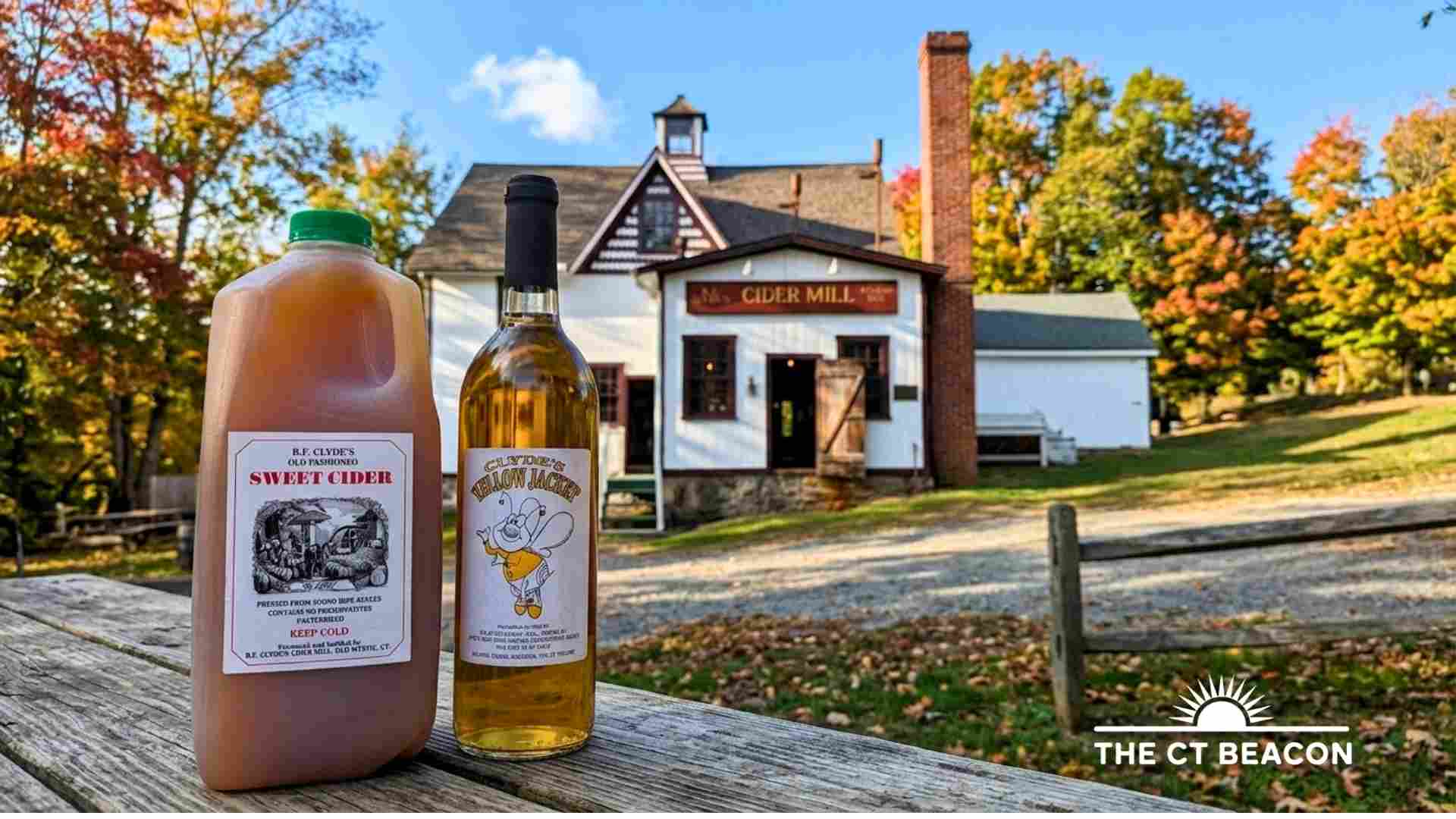
B.F. Clyde’s Cider Mill is now open for the 2026 season, beginning another fall of fresh-pressed sweet cider, cider donuts, traditional hard cider, apple wine and one of the most unusual pieces of working history in Connecticut.
The family-owned Old Mystic landmark opened for the season September 1 and is currently scheduled to operate seven days a week from 9 a.m. to 6 p.m. at 129 North Stonington Road.
But calling Clyde’s a cider shop doesn’t quite explain why generations of families make a trip here every fall.
The mill has been family-owned since 1881. Fourth, fifth and sixth generations of the family still work in the business. Apples are still crushed and pressed using historic machinery powered by steam. Visitors can watch the machinery operate, descend into the cellar for traditional hard cider tastings, sample apple wines in a converted grist mill and leave with a bag of cider donuts.
Clyde’s calls itself the oldest steam-powered cider mill in the United States.
More precisely, it is the last operating steam-powered cider mill in the country, according to the mill, and its historic cider-making machinery has been recognized by the American Society of Mechanical Engineers as a National Historic Mechanical Engineering Landmark.
It isn’t a reproduction of an old cider mill.
It’s the real thing.
A Mystic Fall Tradition Since 1881
The story begins with Benjamin F. Clyde.
In 1881, Clyde began producing cider from apples he had pressed at other local mills. He eventually rented a press before purchasing his own mill in 1897.
The equipment that followed would become the heart of the operation visitors still come to see.
Clyde purchased a screw press manufactured by Boomer & Boschert of Syracuse, New York. The company also supplied the apple grater, elevator and cider pump, along with plans for the mill building.
The machinery was installed in 1898.
At the time, cider mills were hardly unusual in rural America.
They served much the same role for apple growers that grist mills did for farmers growing grain. Orchards could bring surplus apples to a centrally located mill, where the fruit could be processed and pressed into juice. Some of that juice could then be fermented into hard cider.
Most of those community mills disappeared.
Clyde’s didn’t.
The Steam-Powered Mill Is Still Working
That’s what makes a visit different from touring a preserved historic building.
The machinery still has a job.
Apples enter the cider-making system and are elevated to a grinder, where they’re reduced to pulp. That pulp is prepared for pressing, and the historic screw press applies the tremendous pressure needed to extract the juice.
The technology was impressive for its era.
According to the American Society of Mechanical Engineers, the all-steel screw press could apply pressure at three speeds and represented one of the last generations of screw presses before hydraulic presses became widespread during the 20th century.
ASME designated B.F. Clyde’s Cider Mill a National Historic Mechanical Engineering Landmark in 1994, recognizing the machinery as a rare survivor of an industry that was once common throughout America’s apple-growing regions.
More than a century after the equipment was installed, Clyde’s still uses the mill to make cider.
When Can You Watch Clyde’s Press Cider?
Visitors don’t have to settle for looking at the machinery.
Clyde’s runs it during the season.
The mill’s typical pressing schedule is:
Tuesday and Thursday: 10 a.m.–noon
Saturday and Sunday: 10 a.m.–noon
The schedule can vary because Clyde’s presses according to production needs, so the machinery isn’t guaranteed to be running continuously throughout those periods.
Even when the press isn’t operating, visitors are welcome to look inside the historic press building.
For anyone specifically interested in seeing the steam-powered machinery at work, a pressing morning is the best time to plan a visit.
How Clyde’s Makes Sweet Cider
Fresh sweet cider is the product that started everything.
Clyde’s purchases its apples from small orchards rather than operating a pick-your-own orchard of its own. The apples are processed at the mill and pressed into cider using the historic equipment.
The finished sweet cider is flash pasteurized on the property.
Visitors can buy cider to take home or drink it while visiting, and seasonal cider drinks have become part of the experience alongside the mill’s baked goods.
That combination has helped turn what was originally a working agricultural business into a fall destination.
You can come to learn how a 19th-century cider press works.
You can also come because you want cider and a donut.
Neither is the wrong reason.
About Those Clyde’s Cider Donuts
For plenty of visitors, the steam engine has competition.
Clyde’s cider donuts have become almost as closely associated with the mill as the cider itself.
The store sells its well-known cider donuts along with other baked goods and seasonal treats. The selection can vary, but the broader shop also carries jarred products, honey from local beekeepers, candied apples made by the family and other locally produced goods.
It’s part bakery, part country store and part historic attraction.
And on a busy fall weekend, the line is evidence that plenty of people know exactly what they came for.
Then There Is the Cider Downstairs
The word “cider” gets considerably more complicated at Clyde’s.
Sweet cider is only part of the story.
Clyde’s also makes traditional hard cider using a process very different from the sweeter, carbonated canned ciders that have become common in supermarkets and bars.
The hard cider begins with apple juice and ferments before aging in oak whiskey barrels.
The process from juice to finished hard cider typically takes about a year.
After fermentation and aging, the hard cider receives relatively little filtration before being sold. That preserves more of the raw, oaky character produced by the barrel.
The result is considerably stronger than many commercial hard ciders.
Clyde’s hard ciders and apple wines generally contain 12 to 14 percent alcohol.
Hard Cider vs. Apple Wine: What’s the Difference?
This is one of the more interesting parts of Clyde’s operation because the two products begin in essentially the same place.
Both the hard cider and apple wine start as fermented apple juice aged in oak whiskey barrels.
What happens afterward separates them.
Clyde’s hard cider is only lightly filtered to remove sediment. That leaves it with a bolder flavor, more pronounced oak character and more bite.
The apple wine receives considerably more filtration.
That additional processing produces a smoother, somewhat sweeter product that is also shelf stable before opening.
So someone expecting Clyde’s hard cider to taste like a modern canned hard cider may be surprised.
This is closer to an older cider-making tradition.
What’s in the Hard Cider Cellar?
The hard cider cellar sits underneath the press building.
That’s where visitors can taste Clyde’s traditional hard ciders and where the product has been made for generations.
Availability changes throughout the season, but Clyde’s 2026 lineup includes several recurring varieties.
The Original is the starting point. It’s dry, without added fruit flavors competing with the oak character of the barrel.
Lucky Lion is also dry and crisp, with a character Clyde’s says some drinkers compare to Scotch.
Blackout goes even further in that direction. It’s Clyde’s most popular hard cider and wine flavor, with strong oak notes that the mill describes as almost reminiscent of whiskey.
Then things get fruitier.
Boomerang combines apple and cranberry for a tart, sweeter cider.
Goodfella adds blackberry and lands on the sweeter end of the lineup.
Yellow Jacket combines apple and orange, producing some sweetness with a citrus bite.
Cherry Bomb adds another fruit-driven option.
Because Clyde’s rotates its hard ciders, individual varieties can change during the season.
The Apple Wine List Goes Much Further
The wine side of the operation offers even more variety.
Clyde’s currently lists 14 apple wines, ranging from dry expressions of apple to much sweeter fruit combinations.
Apple Wine is the driest of the wine lineup.
Spiced Apple uses mulling spices for a distinctly fall-oriented version.
Spider Cider combines sweetness with pumpkin spices and can be warmed or used in a hot toddy.
Strawberry Bliss is the sweetest wine in the lineup, combining apple and strawberry.
Blueberry Spinner combines apple and blueberry.
Apple Raspberry leans sweet but tart.
Cider House Blend combines apple, orange and cranberry.
Several of the hard cider varieties, including Original, Lucky Lion, Blackout, Boomerang, Goodfella and Yellow Jacket, are also produced as wines.
The distinction comes back to filtration.
Same roots.
Different finish.
Yes, You Can Taste Them for Free
Clyde’s offers separate hard cider and wine tastings throughout its season.
And the tastings are free.
No purchase is required and no reservation is necessary.
Visitors can sample up to four hard ciders and up to four wines at their respective tasting locations.
Hard cider tastings take place in the cellar beneath the press building.
Wine tastings are held in the tasting room, which has its own connection to the property’s history: the building is a converted grist mill once used to produce johnnycake meal.
Tastings are first-come, first-served.
Current tasting hours are:
Monday–Saturday: 9 a.m.–6 p.m.
Sunday: 10 a.m.–6 p.m.
Everyone participating in a tasting must show a valid ID, regardless of age or appearance. Clyde’s does not accept expired IDs or photographs of identification.
Connecticut alcohol rules also mean Clyde’s cannot sell its hard cider or wine before 10 a.m. on Sundays.
A Few Clyde’s Flavors to Know Before You Taste
If you don’t know where to start, the tasting bottles are generally arranged from driest to sweetest, and the staff can help narrow the choices.
For something dry: Original or Apple Wine.
For strong oak character: Blackout.
For dry and crisp: Lucky Lion.
For tart cranberry: Boomerang.
For something sweeter: Goodfella.
For fall spice: Spiced Apple or Spider Cider.
For very sweet fruit: Strawberry Bliss or Blueberry Spinner.
One warning for anyone accustomed to mass-market hard cider: remember the alcohol content.
At 12 to 14 percent ABV, Clyde’s hard cider is much closer to wine strength than a typical bottle or can of commercial cider.
Can You Bring Back a Clyde’s Growler?
Yes.
Clyde’s sells 64-ounce growlers of hard cider and offers growler refills.
There are a couple of important rules.
Clyde’s refills growlers rather than exchanging them, so customers should clean their growler before bringing it back. The mill can only refill glass growlers that have a stamped or imprinted 64-ounce measurement.
Wine cannot be used for growler fills.
The refill program is for hard cider.
Hard cider should also be kept cool after purchase. Clyde’s recommends refrigeration.
There’s More Than Cider
The tasting room also contains Clyde’s gift shop, with merchandise and locally made products that can include handmade earrings, postcards and art prints.
Elsewhere at the mill, visitors can browse honey produced by local beekeepers, jarred foods, family-made candied apples, baked goods and other seasonal products.
That makes it possible to spend considerably more time at Clyde’s than simply buying a gallon of cider and heading home.
Watch the press.
Get cider and donuts.
Explore the store.
Go downstairs for a hard cider tasting.
Visit the wine tasting room.
Browse the gift shop.
It’s effectively several different experiences spread across the historic property.
Is B.F. Clyde’s Cider Mill Good for Kids?
Yes.
Clyde’s welcomes children of all ages.
The working mill is also an opportunity to show kids a piece of machinery doing the job it was actually designed to do more than a century ago.
There is no alcohol involved in the regular sweet cider, and the bakery, cider and mill demonstration make Clyde’s an easy family fall stop.
Just don’t confuse the two kinds of cider.
The traditional hard cider and apple wines are 12 to 14 percent alcohol and are strictly for adults 21 and older.
Can You Pick Apples at Clyde’s?
No.
This is one of the most useful things to know before making the trip.
B.F. Clyde’s is a cider mill, not a pick-your-own orchard.
The mill purchases apples from small orchards and uses them to produce its cider.
If apple picking is part of your fall plans, you’ll need to visit an orchard separately.
Can You Bring a Dog?
Yes, with restrictions.
Leashed pets are permitted on the grounds.
They aren’t allowed inside the buildings or on the porch, and visitors need to bring whatever they need to clean up after their pets.
Parking Can Be the Hardest Part of a Fall Visit
Clyde’s popularity comes with one predictable problem.
It gets busy.
The main parking lot can fill during peak periods, particularly on fall weekends.
Clyde’s asks visitors to try the main lot first and to respect posted no-parking areas and neighboring properties if parking along nearby roads.
An auxiliary lot is available at 49 North Stonington Road. It’s approximately four-tenths of a mile from the mill, so visitors using it should expect a walk.
If your schedule is flexible, a weekday visit can make the entire experience easier.
If you’re coming specifically to see the press operate, Tuesday or Thursday morning offers the combination of a weekday visit and a scheduled pressing window.
Clyde’s Isn’t a Museum, and That’s the Point
There are plenty of places where historic machinery survives behind ropes.
Clyde’s is different.
Benjamin Clyde started making cider in 1881.
He acquired his own mill in the 1890s.
The equipment installed in 1898 survived the arrival of hydraulic presses, mass food production, supermarkets, interstate highways and more than a century of changes in how Americans buy their food.
The family survived with it.
Today, fourth, fifth and sixth generations are involved in the operation.
Every September, the doors open again.
Apples arrive.
The steam-powered machinery starts moving.
Fresh cider begins flowing.
And people line up for cider donuts.
That’s why B.F. Clyde’s Cider Mill is more than another place to add to a Connecticut fall checklist. It’s a piece of New England’s agricultural and industrial history that never stopped doing its job.
2026 Visitor Guide
Attraction: B.F. Clyde’s Cider Mill
2026 Season Opening: September 1, 2026
Current Hours: 9 a.m.–6 p.m., seven days a week
Location: 129 North Stonington Road, Mystic, CT 06355
Admission: Free
Children: Welcome
Pets: Leashed pets allowed on the grounds; not inside buildings or on the porch
Apple Picking: No
Sweet Cider: Available
Cider Donuts and Baked Goods: Available
Hard Cider: Available for adults 21+
Apple Wine: Available for adults 21+
Alcohol Content: Hard cider and wine are generally 12–14% ABV
Tastings: Free; no reservation required
Hard Cider Tastings: Cellar beneath the press building
Wine Tastings: Tasting room
Tasting Hours: Monday–Saturday, 9 a.m.–6 p.m.; Sunday, 10 a.m.–6 p.m.
Typical Pressing Schedule: Tuesday, Thursday, Saturday and Sunday, 10 a.m.–noon
Parking: Main lot plus auxiliary parking at 49 North Stonington Road
Thanksgiving: Closed
Shipping: Not available
Preorders/Call-Ahead Orders: Not available
Hard Cider Menu
American Society of Mechanical Engineers History
More information is available at the Event Website link below.
Featured image is an artistic representation inspired by the event and may not depict the actual people, location, or activities shown.