


- This event has passed.
Holy Ghost Festival Stonington
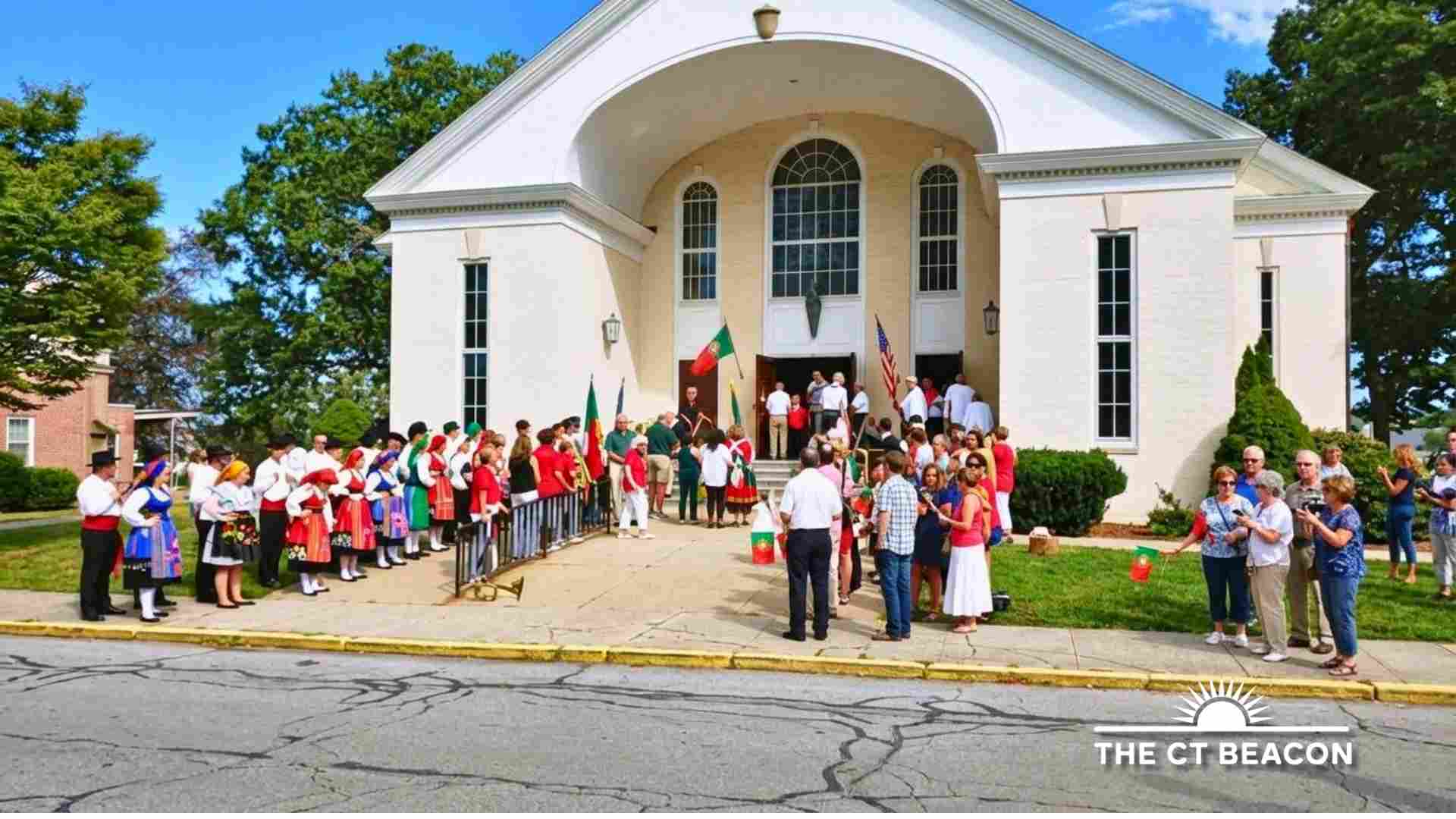
Holy Ghost Festival Stonington returns to the narrow streets of Stonington Borough on Saturday and Sunday, September 5–6, continuing a Portuguese tradition rooted in the community established by Azorean sailors more than a century ago.
Processions will move through the Borough both days, with music and gathering at the Portuguese Holy Ghost Society, a free traditional meal for everyone on Sunday, and, as the weekend ends, the drawing that begins the tradition again for another year.
But to understand why a crown is carried through Stonington’s streets and why hundreds of people are invited to sit down and eat for free, you have to go back much further than the first Holy Ghost festival held here.
You have to start with a queen, a famine and a promise.
A Queen, a Crown and a Promise
The story at the center of the Feast of the Holy Ghost has been handed down through generations of Portuguese families.
Queen Saint Isabel of Portugal was renowned for her devotion to the poor. According to the tradition, during a devastating famine she prayed to the Holy Spirit for relief and promised her crown in return.
Different versions of the centuries-old story vary in their details. In one, disastrous weather ended and the crops recovered. In another, ships arrived carrying desperately needed grain.
What remains constant is what happened next.
The hungry were fed.
That act of charity became the foundation of the Festa do Espírito Santo, or Feast of the Holy Ghost, a tradition carried from Portugal through the Azores and eventually into Portuguese communities around the world.
Including Stonington.
The Azoreans Who Came to Stonington
Stonington’s Portuguese story is inseparable from the sea.
Portuguese settlement in the Borough began around the 1840s as sailors recruited from the Azores aboard Stonington whaling vessels arrived in the home port and began putting down roots.
More followed.
Over the decades, immigrants arrived from islands including Faial and São Miguel. Portuguese families established themselves particularly in the section of the Borough historically known as “South of the Cannons.”
They worked aboard fishing and whaling vessels, in local mills and elsewhere around the community.
They also brought their traditions with them.
One of the most important was the Feast of the Holy Ghost.
Exactly when Stonington held its first festa isn’t known. Historical newspaper accounts document celebrations before the Portuguese Holy Ghost Society was formally organized, and the Stonington Historical Society traces the tradition in the Borough to the Portuguese community that began taking shape in the mid-19th century.
By 1914, Stonington had its own ceremonial Holy Ghost crown.
More than a century later, that crown remains at the center of the celebration.
Follow the Crown Through the Borough
The processions are among the most visible parts of Holy Ghost weekend.
Saturday’s procession begins at 5 p.m. The celebration continues Sunday morning with processions at 9:30 and 11 a.m.
The crown and scepter travel through the streets of the Borough as part of a tradition that historically connects the Portuguese Holy Ghost Society with St. Mary Church.
It has happened in these streets for generations.
Past the old houses.
Through the former Portuguese neighborhood.
Past the cannons overlooking the water.
And eventually back to the Holy Ghost Society on Main Street.
The crown isn’t simply festival decoration. It represents the charitable promise at the heart of the Holy Ghost tradition and spends much of the year outside the Society altogether.
Its journey actually begins long before Labor Day weekend.
Seven Domingos and a Year With the Crown
One of the most fascinating parts of Stonington’s Holy Ghost tradition happens largely out of public view.
The crown and scepter spend portions of the year in the homes of seven people known as the Domingos.
The first Domingo keeps them for most of the year. As the festival approaches, they move through the homes of the remaining Domingos, traditionally spending a week with each.
The crown is displayed prominently in the home, often surrounded by flowers, candles and symbols of the Holy Ghost.
The final responsibility falls to the mordome, or sponsor, associated with the Seventh Dominga.
The crown then returns to the procession and the feast.
It means the festival isn’t really a two-day event at all.
The public celebration lasts a weekend.
The tradition lasts all year.
Why Everyone Is Invited to Dinner
At noon Sunday comes one of the most important parts of the entire weekend.
Everybody eats.
The Portuguese Holy Ghost Society provides a complimentary traditional Portuguese meal, and the invitation isn’t limited to Society members or Portuguese families.
It’s open to everyone.
That isn’t simply Stonington hospitality added to a religious festival.
Feeding people is the festival.
Traditional Holy Ghost sopas connects Sunday’s meal directly to the story of Saint Isabel and the feeding of people during famine.
Portuguese sopas isn’t necessarily what an English speaker imagines when hearing the word “soup.” The traditional dish uses bread soaked in a deeply flavored broth, historically prepared with beef and chouriço and traditionally accompanied by mint.
Decades ago, the Stonington Historical Society recorded that the elderly, sick and children were traditionally to be fed first, reflecting the charitable principles associated with Saint Isabel.
The scale could be extraordinary.
A 1987 history of the Stonington feast recalled preparations to feed as many as 2,000 people.
So when someone who has never attended walks through the door Sunday and is handed a meal, they’re participating in the same central act that generations before them considered the purpose of the feast.
You feed whoever comes.
Sweet Bread, Food and an Afternoon Together
The meal doesn’t end Sunday’s celebration.
Traditionally, the afternoon continues around the Holy Ghost Society with music, food and an auction that has helped support the feast.
Portuguese sweet bread, or massa sovada, has long played a particularly important role.
Historically, families prepared loaves and other items to contribute to the auction, helping pay the considerable expense of feeding the community and staging the celebration.
It’s another example of how much work exists behind a weekend built around giving things away.
The food may be free to the person sitting down at noon.
Somebody still had to prepare it.
And in Stonington, generations of volunteers have done exactly that.
What Happens at 6 p.m. Sunday?
The final major event on the schedule may be the one most confusing to someone encountering Holy Ghost for the first time.
At 6 p.m. Sunday, the drawing of the Domingos begins.
It isn’t a conventional raffle.
People enter for the opportunity to become one of the seven Domingos who will care for the crown and scepter during the coming year.
Names are drawn, and those selected take their place in the next annual cycle of the tradition.
Historically, people who entered but didn’t draw a Domingo could instead draw três bolos, or “three breads,” signifying a contribution of sweet bread toward the next celebration.
And the Seventh Dominga carries particular significance.
That person becomes the mordome, the sponsor of the following year’s feast.
Think about what that means.
The 2026 Holy Ghost Festival doesn’t really end when the final name is drawn Sunday evening.
The 2027 festival begins.
The crown leaves the weekend celebration and starts another journey through the community.
Eventually, Labor Day approaches again.
And the crown returns to the streets.
The Holy Ghost Society’s Home on Main Street
The Portuguese Holy Ghost Society is itself part of the story.
The Society is located at 26 Main Street in Stonington Borough and has occupied its current location since 1926.
The organization grew from the Portuguese community established around Stonington’s maritime industries, with early members including fishermen and mill workers.
Its historic building has served as much more than the headquarters of a social organization.
For generations of Portuguese-American families, it has been a place where culture, food, faith and community could survive long after their ancestors left the Azores.
The annual festa may be the clearest expression of that.
A Stonington Labor Day Tradition
On the Catholic calendar, Pentecost and the Holy Spirit are celebrated in the spring.
Stonington does things differently.
The Borough’s Holy Ghost celebration moved to Labor Day weekend to avoid conflicts with Holy Ghost celebrations in other Portuguese communities. Eventually, the new date became a tradition of its own.
For generations of Stonington families, Labor Day weekend came to mean something very specific.
The Holy Ghost hymn.
The crown moving down the street.
Portuguese flags.
Sopas.
Sweet bread.
Families gathering outside the Society.
And another generation learning what all of it means.
The community surrounding the festival has changed enormously since Portuguese sailors began settling here in the 1840s.
The whaling ships are gone.
The mills that employed later generations are gone.
Many descendants moved beyond the small neighborhood where their families first settled.
But on Labor Day weekend, the crown still comes out.
The procession still moves through Stonington Borough.
And at noon Sunday, anyone who arrives hungry can still be fed.
Event Details
Event: Holy Ghost Festival Stonington
Dates: Saturday–Sunday, September 5–6, 2026
Location: Portuguese Holy Ghost Society
Address: 26 Main Street, Stonington, CT 06378
Admission: Free and open to all
Saturday, September 5
Festival Begins: 5 p.m.
Procession: 5 p.m.
Sunday, September 6
Morning Processions: 9:30 and 11 a.m.
Complimentary Traditional Portuguese Meal: Noon
Drawing of the Domingos: Begins at 6 p.m.
Holy Ghost Festival Stonington continues a Portuguese and Azorean tradition preserved in the Borough for generations, with processions, the ceremonial crown, traditional food and a free community meal at the heart of the celebration.
More information is available at the Event Website link below.
Featured image is an artistic representation inspired by the event and may not depict the actual people, location, or activities shown.
Historic Stonington – The Portuguese Feast of the Holy Ghost